
I’m of two minds about the new legacy sequel Karate Kid: Legends. I recognize and immediately acknowledge that Karate Kid: Legends is not a good movie, and no amount of critical backflips that I do will excuse that. It’s frankly insane to try and think about the logic that went into its construction and who thought any of this was a good idea. It’s relentlessly silly, slipshod, and derivative. It’s edited to within an inch of its life, has only the most basic of plot elements lifted from much better movies, and the soundtrack is all over the place.
But I also can’t say that I was bored or that I wasn’t thoroughly entertained by what I was seeing, and not necessarily in a “this is so awful it’s secretly great” kind of way. I was genuinely charmed by this hyperactive, scrappy mess of a movie, even if it stands up to almost no critical scrutiny whatsoever. Karate Kid Legends is an example of a bad movie that’s inherently watchable, which, given the state of most modern tentpole blockbusters and franchise movies these days, is something rare and special.
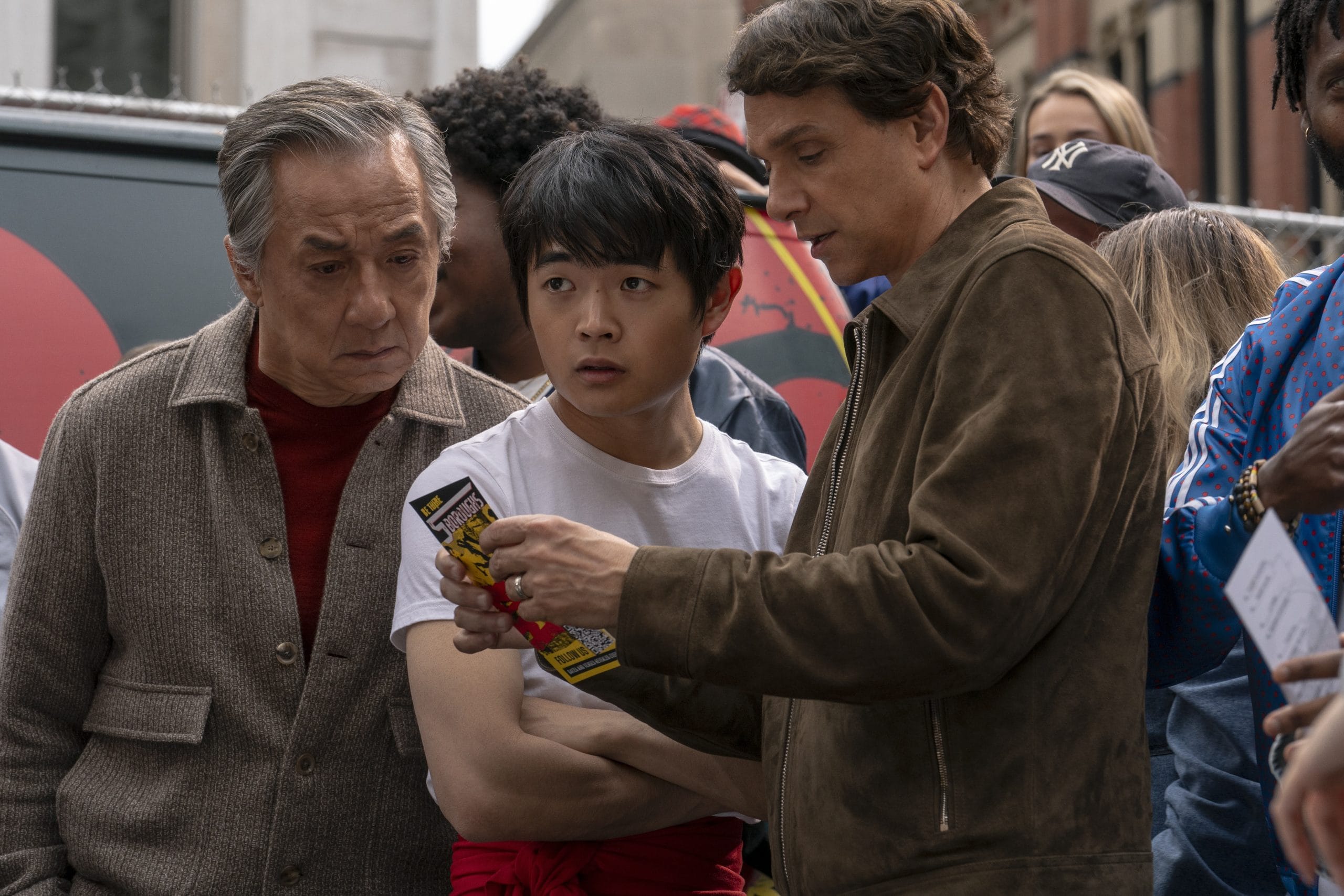
Xiaoli Fong (Ben Wang) is a budding teenage kung fu master, learning at a Beijing dojo under the tutelage of shifu Mr. Han (Jackie Chan, reprising his role from the 2010 reboot of the franchise, but never once mentioning what his character did in that movie). Li’s mother (Ming-Na Wen) doesn’t want him learning how to fight, having lost one son already to “the path.” She’s also packing up with Li and moving to New York City for a new job opportunity. Naturally, Li isn’t too happy about this, but he makes the most of things by befriending and crushing on a cool girl named Mia (Sadie Stanley) and striking up an unlikely friendship with her pizza place owning ex-boxer father, Victor (Joshua Jackson, who delivers a good and warm performance despite being one of the least convincing New Yorkers in screen history). But wouldn’t you know it, Mia’s ex-boyfriend (Aramis Knight) is a karate champion and an enormously jealous bully, and his ruthless sensei (Tim Rozon) is also a loan shark that wants to collect on a debt owed by Victor. Despite his mom’s insistence to give up martial arts, it’s no shock that Li will eventually enter a local tournament to help save the pizza place, beat up his crush’s ex, and honour the memory of his dead brother. To do so, he’ll need the guidance of Mr. Han and the legendary Karate Kid himself, Daniel LaRusso (Ralph Macchio).
Karate Kid: Legends is the kind of misguided project that I get so giddy about that I almost don’t know where to begin. There’s so much to talk about, and the whole thing is certainly an experience. Director Jonathan Entwistle (I Am Not Okay With This, The End of the F***ing World) and writer Rob Lieber (Peter Rabbit, Goosebumps 2: Haunted Halloween) open with a flashback to the second Karate Kid instalment, which is fitting since the overall plot of a young person in a strange land fighting for a girl he’s smitten with is taken more or less from that movie. But it’s also clear that there are many competing visions as to what Karate Kid: Legends should be. It wants to be a stand alone story built around a new, capable hero, but also a nostalgia trip designed to bring in fans the franchise has picked up along the way. Not only is Karate Kid: Legends scare to be a reboot, it’s scared to be a Karate Kid movie.
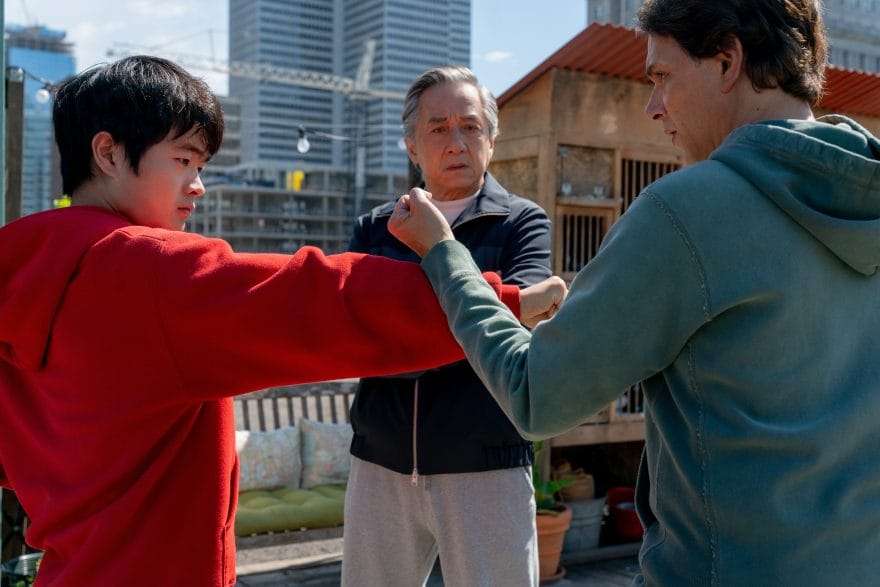
In terms of tempo, storytelling, editing, and approach, it often feels like Sony is trying to make this into a teen friendly Spider-Man type franchise, at one point explicitly calling Li a Chinese version of Peter Parker, and with Entwistle overusing split-screens and a plethora of wipes to make the early stages move like the reading of a comic book. But it’s also trying to be something akin to the Creed movies, where people confront their legacies, dust themselves off after losses, and come back harder than ever, especially in the subplot that finds Li improbably training Victor for an in ring comeback. There are as many training montages in this thing as there were in Rocky IV, which is bad from a technical and storytelling perspective (especially since it appears as if half the story has been axed somewhere along the way here), but they’re all well edited, soundtracked, and suitably rousing. And the flashy style employed by Entiwstle combined with Lieber’s gleefully hokey “we gotta save the pizza place” plot are more in line with dance movies like the Step Up and Breakin’ franchises. While Li doesn’t suffer a shred of culture shock upon setting down in NYC (thanks to going to an American school in Hong Kong growing up, as noted in a tossed off bit of dialogue), the film built around the character suffers from a major identity crisis and colliding influences that don’t always play well with each other.
Credibility and depth are not strong suits of Karate Kid: Legends, a movie that barrels along so speedily (clocking in a full twelve minutes shorter than any other film in the franchise) that it hopes no one notices this whole thing is held together by good will, chewing gum, and wishful thinking. Basic is the watchword all around. While Wang gives a charming and physically capable leading performance that makes one somewhat eager to see more adventures with this character, his motivations are – like everything else here – summed up in a couple of bits of exposition. Karate Kid: Legends is so often in a hurry to get to the good stuff, meaning the plethora of well constructed and choreographer fights, that anything else is left in the dust. In a twist that’s both novel and bound to irk fans of the franchise, neither Chan nor Macchio have much of anything to do until the film crosses the halfway point, and even then, the characters feel superfluous. (Entiwistle also has to cleverly edit around the older actor’s physical abilities, particularly Chan’s.)
The “New York” settings (which were mostly shot in Montreal or on obvious sound stages) are wholly inauthentic, but the film still bursts with visual life, aided by gorgeous cinematography from frequent Entwistle collaborator Justin Brown. The film’s ludicrously implausible martial arts tournament – The 5 Boroughs, which feels like a kung fu dance off version of the Rucker basketball tournament – is stunning to look at, even if there’s no way such an event could ever exist, let alone be a thing of local legend. Also, everything except the climactic fight is breezed over in a matter of seconds, so maybe none of that artifice is of any importance. Visually, sonically, and in terms of overall vibes, Karate Kid: Legends made me smile from ear to ear, but in my head I was always questioning what it was exactly that I was watching. The disconnect between my lizard brain desire for beat-‘em-up action and the thinking mind’s desire to make sense of all the chaos was enormous throughout the film.
The best movies to watch as a critic are exceptional, thought provoking works of art, staggering debacles, and movies that are getting just as much right as they are wrong. Karate Kid: Legends belongs in that all too rare third category, but it’s still better than being outright forgettable. It knows what the audience likely came to see, and it gives it to them in the hopes they won’t put any amount of scrutiny into what they just saw. Is Karate Kid: Legends a bad movie. Yes. Are there certain people I would recommend it to because I know they’ll have a good time with it? Also, yes. I would happily watch another one of these. There’s great potential here to keep going, but if this franchise wants to continue down this path, a bit more streamlining is necessary.
Karate Kid: Legends opens in theatres everywhere on Friday, May 30, 2025.
