
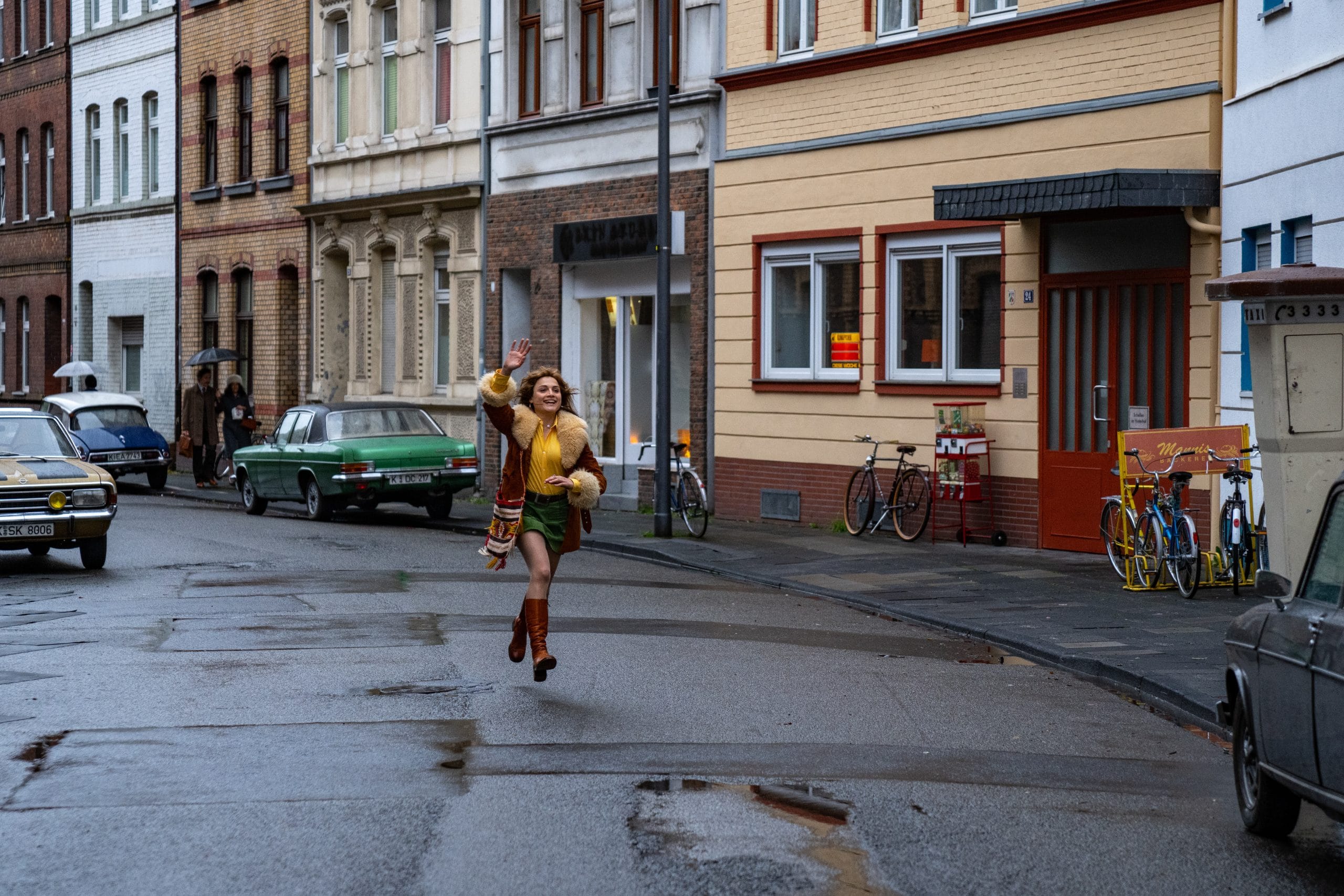
The historical, jazz world set drama Köln 75 exists in an awkward, unconvincing, but well intentioned space. It’s a niche film about the creation of a very specific work of art that I’m sure many people outside the jazz community don’t even know exists, but it also wants to be a mainstream crowd pleaser. The two tones set by writer-director Ido Fluk (The Ticket) are hyper-specific and unpleasingly broad, and from moment to moment it’s hard to tell which movie will emerge next. It wants to be equally about the recording of a landmark record that arose from a difficult situation and the people who worked to make it a reality, but Köln 75 never gives the viewer enough information to fully invest in either topic, making it only a passing entertainment in Fluk’s brightest moments.
Vera Brandes (Mala Emde) isn’t like most teenagers of the 1970s, especially those living in Cologne, Germany. Instead of listening to pop or rock music, socially conscious and outspoken Vera is drawn to jazz, a genre that tends to draw an older crowd. At the age of sixteen, she’s able to endear herself to saxophonist Ronnie Scott (Daniel Betts) so much that he asks her to book at tour for him. She’s bluffing and lying about her age, of course, but headstrong Vera and her friends prove to so good at promoting shows that she decides to become a booker by profession. This greatly discourages Vera’s obstinate, conservative, often cruel father (Ulrich Tukur), who wants her to follow in his footsteps as a dentist.
Towards the end of 1974, Vera becomes particularly enraptured with the work of jazz pianist Keith Jarrett (John Magaro), who has embarked on an ambitious tour that’s pure, uncut improvisation every night. Vera wants to book Jarrett for a grand showcase worthy of his talents, but doing so in Cologne proves difficult. The only house big enough to hold a Jarrett show would be the local opera house, whose bookers says Vera can only use the space if she pays ten grand in advance and agrees to hold the show after 11:00pm (following that evening’s opera) in the middle of January. Vera is able to secure the funding from her mother (Jördis Triebel), under the condition that she has to quit the music business if she proves unable to pay back the loan. But Vera’s problems with booking the show prove to be just the beginning, as a host of last second logistical issues threaten to derail everything before a burnt out and physically suffering Jarrett is able to take the stage.
The first signs that Köln 75 could be on rocky ground are noticed early on, with a fake-out opening that switches perspectives to someone – an American music journalist named Michael “Mick” Watts, played by Michael Chernus – explaining the history of fake-out openings. Thankfully, Fluk doesn’t press too hard on making Köln 75 into a project that perpetually and unnecessarily breaks the fourth wall, save for a few more interludes involving Watts, one of which (talking about how hard it is to truly improvise music in front of an audience) is illuminating and entertaining to behold. But the opening hints at a movie that feels unsure of what path it wants to take, and eventually whether it wants to honour the work itself or the people who made it a reality.

Köln 75 moves at a fast enough clip, nicely reflecting Vera’s hard charging nature, but Fluk isn’t doing enough to make those who might not be hardcore jazz aficionados interested in what’s going on. Made in part to capitalize on the 50th anniversary of the recording of the best selling solo live jazz album of all time, Köln 75 is clearly building towards a grand finale, but a lot of the lead up to those moments is reduced to musical minutiae and dramatic cliches. On paper, Vera sounds like an interesting and complicated person who was able to balance her social beliefs and professional desires with equal fervour. But all Fluk is able to come up with are recognizable and familiar platitudes about being young and full of dreams. There are attempts to talk about her personal relationships, friends, and family issues, but they’re thinly sketched, and her advocacy efforts are reduced to montage. Similarly, when the story switches around the midway point to more focus on Jarrett, who Magaro plays with great empathy and warmth to go along with the character’s frustrations, Fluk doesn’t have much more to offer than traditional cliches about broken, depressed musicians whose best days might be behind them.
Fluk’s script and direction aren’t tightly constructed, and much of the heavy lifting falls to the cast (including a lead who’s good, but looks far too old to be playing a teenager) and overall legend of the album to carry things along, and if you’re unfamiliar with the concert recording in question, Köln 75 might just feel like another movie about victory being ripped from the jaws of defeat. We see the determination and fears of the characters and the struggles faced, but there’s little to be known outside of the basics. Things come together in the final thirty minutes of the film, which sees Vera frantically trying to fix a bunch of potential show cancelling issues at the eleventh hour, and one thinks that Köln 75 has also pulled itself towards some degree of recommendation.
But then the big moment arrives, and it’s time for the show to begin, and just as Jarrett takes the stage, the final death blow arrives. After hyping up a musical experience that changes the lives of all who witness the performance and hear it on wax later, Köln 75 reveals itself to be one of those stories based on famous tunes that can’t secure the rights to the material, a la Jimi: All Is By My Side and the dreadful Bowie biopic Stardust. Fluk’s film, for whatever reason, is robbed of its entire reason for being. We’ve seen all of this work, and while it’s appreciated in an historical context, there’s no actual payoff here. Instead of hearing Jarrett’s crowning achievement, all the viewer gets is a familiar pop song that has nothing to do with the story whatsoever played over depictions of people hearing something completely different. I won’t fully speculate as to why Köln 75 doesn’t play any of the legendary music to come out of the Cologne concert, because there could be a lot of budgetary or personal reasons, but I hope the filmmakers only found out late into production and it was too late to turn back. It’s a final twist of the knife to those unfamiliar with 70s improvisational jazz who might’ve been interested to see what all the hubbub was about. Instead, it’s the last sour note to a movie that was already out of tune.
Köln 75 opens at Cineplex Varsity in Toronto, The Bookshelf in Guelph, VIFF Centre in Vancouver, and Cinecenta in Victoria on Friday, October 31, 2025. It expands to additional cities in the following weeks.
