
For his first feature film, Dust Bunny, television veteran Bryan Fuller attacks the screen like a man possessed. A visual phantasmagoria of styles, tones, colours, sounds, and focused absurdism, Dust Bunny is both familiar and unique. To unpack the number of global influences that have gone into writer-director Fuller’s kinetic, darkly comedic fairy tale would take forever. It’s a niche film and a crowd pleaser at the same time; a studious exercise in genre homage that seeks to give audiences a chaotic mash-up the likes of which they’ll never see again. Taking cues from Chinese action cinema, French blockbusters of the 90s and early 2000s, Tim Burton, Ridley Scott, Jacques Demy, Steven Spielberg, the John Wick and Tremors franchises, Roald Dahl, and about two dozen other things I know I’m forgetting, Dust Bunny is so packed to bursting with a love of cinema that if one bit isn’t working for the viewer, they should just wait a moment or two because something entirely different might come along that will work better.
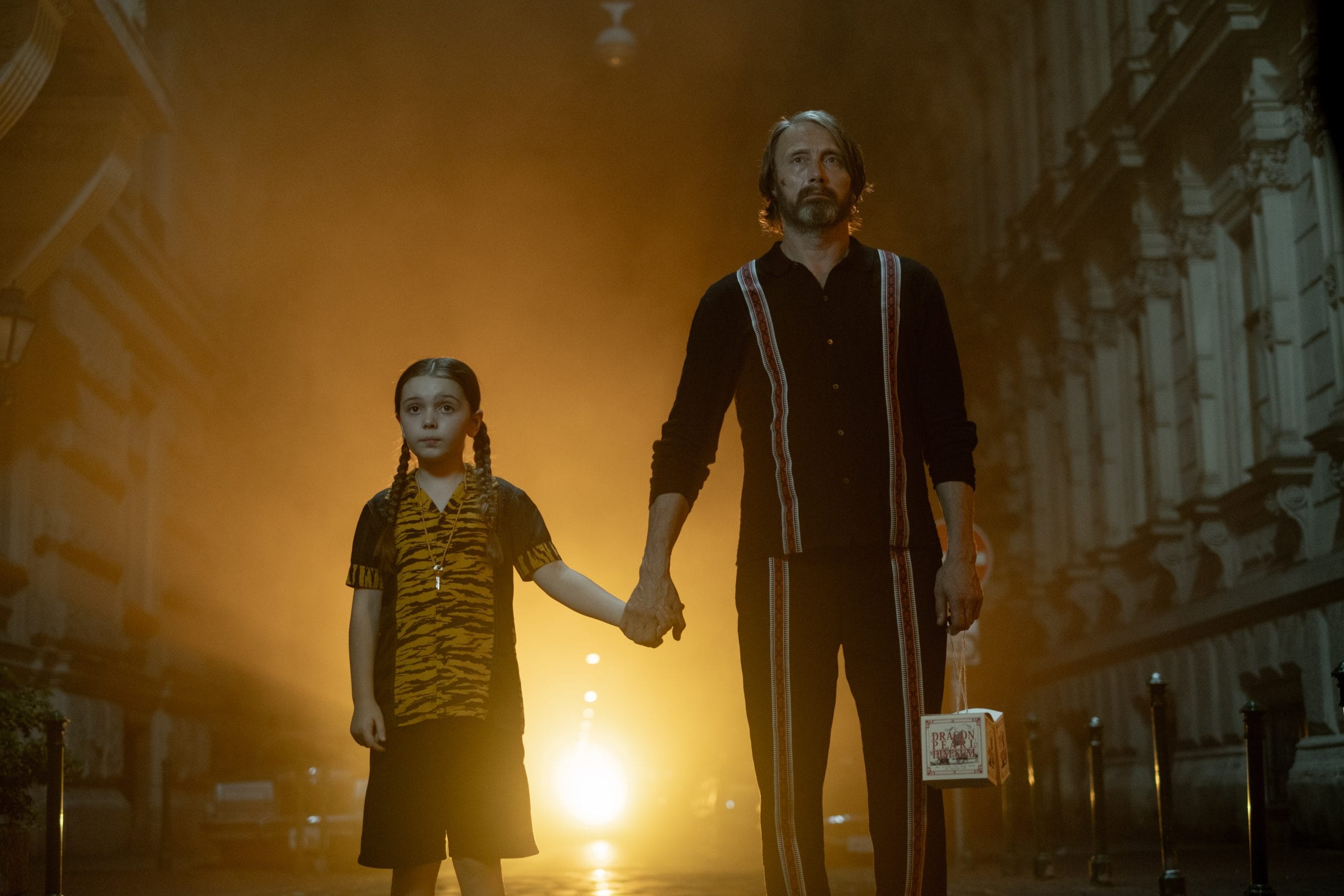
In a hyper stylized, unnamed city that looks like it’s straight out of a gothic colouring book lives young Aurora (Sophie Sloan), an 8 year old girl with an unusual problem. There’s an enormous monster under her bed that comes out at night and will eat anyone who walks across the floor, including her unsuspecting parents. Oddly, this isn’t the first time this has happened, but eventually Aurora can tell you all about that herself. She’s sick of it, and turns to her mysterious neighbour-with-no-name (Mads Mikkelsen) for help getting rid of the creature. This taciturn, skeptical neighbour just so happens to be a hitman, one who Aurora follows one night and thinks she sees him killing a monster. The man is loathe to take the job because not only does he not believe in monsters, but he thinks this “creature” is actually other hitmen sent to kill him who got the wrong apartment. The two begin to bond, and eventually it becomes apparent that this monster is very real. And very hungry.
Visually, Dust Bunny is a lot to take in, reliant on a lot of fluid motion, clever colour grading, and ingenious special effects, all crammed within an ultra-wide 3:1 aspect ratio so rarely used that it hasn’t been seen in a mainstream release since Napoleon in 1927. Dust Bunny is alive with experimentation; the kind of movie where one can feel the filmmaker’s enthusiasm for trying things out they might never be able to attempt again. And thematically, Fuller (Hannibal, Pushing Daisies) has found a story that can match all of his opulent production design, creatures, costumes, and performances. While Dust Bunny is one of the most glorious go-for-broke productions I’ve ever seen, Fuller proves to be a detail oriented filmmaker who’s able to keep a handle on something so unwieldy that it’s always threatening to shoot off into space.
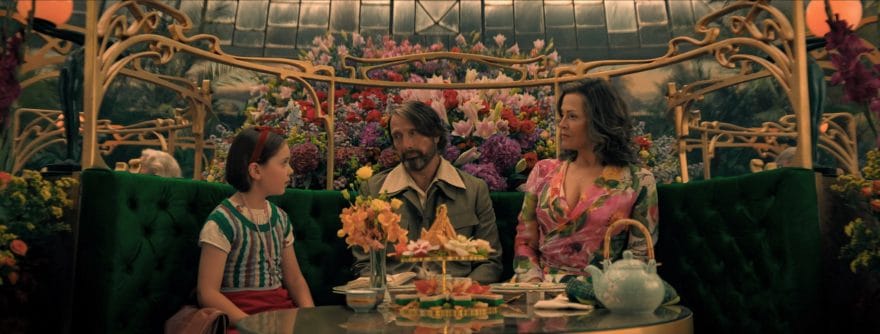
As crazed as the visuals are, Dust Bunny moves at a careful, brisk pace that metes out little details about young Aurora’s situation and the mystery man’s profession over time, eventually extending to include a fully invested and gleefully wry Sigourney Weaver as the hitman’s displeased handler and David Dastmalchian as a rival killer out for revenge. The relationship between the charming young Sloan and stoic Mikkelsen is built upon a great give and take between the performers, both of whom refuse to blend into the candy coated backgrounds. Everyone in front of the camera and behind it knows exactly the kind of movie they signed up for, even if their characters all feel like they’ve been brought in from entirely different projects,
The target audience for Dust Bunny is almost impossible to discern outside of saying that it’s made for people who enjoy the widest range of cinema possible. It’s violent, childish, scary, silly, earnest, and gleefully sarcastic all at the same time. (Although it’s appeal would largely be with viewers on the younger side, it’s a shame that this has been saddled with an R-rating in the U.S., which will limit its potential, at least until it’s available to watch at home, where I could see this building a massive cult following.) It’s built for maximum form and a function all its own. None of this is meant to be taken too seriously, but Fuller treats the viewer to something that’s an artistically minded thrill ride. Like a Grimm fairy tale, Dust Bunny ventures into the darkness, and colours over cliches with a lot of whimsy and wonder, but never at the expense of the sharper edges.
Dust Bunny pulls from a lot of different corners of the cinematic world to create one of the most original movies of the year. At times, you might think you’ve seen a lot of what happens in Fuller’s film before, but you’ve never seen it done quite like this. It’s a trip worth taking.
Dust Bunny opens in theatres everywhere on Friday, December 12, 2025. Dust Bunny screened as part of the 2025 Toronto International Film Festival.
