

Although Avatar: Fire and Ash is yet another gorgeous looking technical achievement from director and co-writer James Cameron, this third instalment in his boundary pushing franchise is a major letdown on every other level. Instead of forwarding the mythology of Pandora, its various tribes, and their war against increasingly encroaching humans, Avatar: Fire and Ash offers up a moderately darker, far more hackneyed take on everything that happened in the preceding film. Not much in Avatar: Fire and Ash is new and refreshing, leading to a leadenly paced experience that will appeal only to those seeking eye candy and not much else. Even then, they should be prepared to dine out on the reheated leftovers of a gourmet meal.
Avatar: Fire and Ash picks up not long after the events of The Way of Water. Plagued by grief and fearing the next human assault, Jake Sully (Sam Worthington) starts salvaging submerged human weaponry and sets about plotting a mission of vengeance, much to the chagrin of his partner, Neytiri (Zoe Saldaña). Another rift in their relationship is caused by the continued presence of Spider (Jack Champion), the human son of deceased evil soldier turned Na’vi avatar, Colonel Quaritch (Stephen Lang), who continues to plot against his former brother in arms with billionaire industrialist Selfridge (Giovanni Ribisi). The atmosphere in the Na’vi’s new watery home isn’t suitable for humans, and with Spider making their clan a target, it’s decided that he should separate from Jake’s family and go to live with some wind traders. But en route, Jake and his family are attacked by another rival tribe, the ash people, led by Varang (Oona Chaplin), who’s waging a ruthless holy war against the Na’vi god she feels abandoned her people. In Varang, Quaritch sees a like minded, blood thirsty warrior that he could use to his advantage.
The best thing that can be said about Avatar: Fire and Ash is that there’s plenty of exceptionally crafted action and fantasy movie spectacle on screen, which is nice because it would be a tremendous bore without these set pieces, and their overall frequency is appreciated. It’s impossible not to marvel at Cameron and company’s highly textured landscapes, tricks of light, and photorealistic waters. The battles on land, sea, and air are breathtaking, and all of the landscapes from volcanic ruins to swampy bogs are impeccably designed. The movement and physicality required by the the actors and stunt performers borders on balletic. Avatar: Fire and Ash, like its predecessors, is an experience first and foremost, with overall storytelling running an increasingly distant second. And given the thin, overly padded nature of this script (which took a total of five credited people to come up with for some reason), Avatar: Fire and Ash is a film that offers all sizzle and only the fattiest part of the steak.
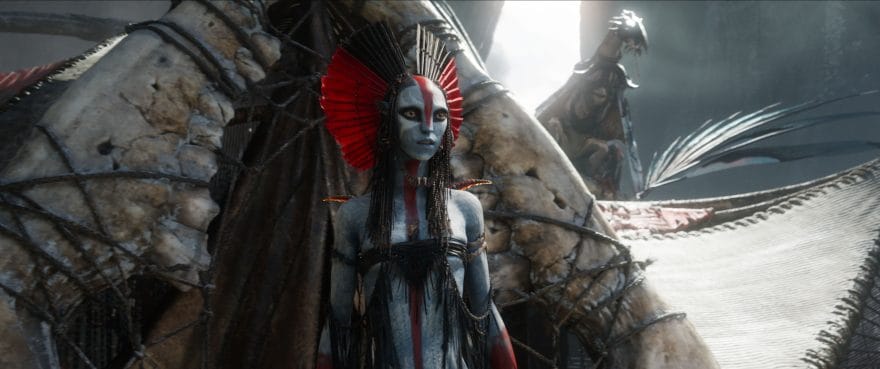
The dialogue, which was never Cameron’s strongest skillset, is cornier and goofier than it has ever been (expect plenty of “dude”s and “bro”s), but this time the metaphorical subtext manages to be just as annoying. One can only hear about the fires of hate and ashes of grief so many times before it starts to lose all meaning. The idea of these characters wrestling with God and their place in the world is interesting, but it all comes saddled with a story that has nothing else new for these characters to say or do. The humans are bad. White saviours can be helpful. Traditions can be broken for the sake of progress. Family over everything. Wash, rinse, repeat.
So little is ever seen of the ash people and their realm that even the settings start to feel like a rehashing of past glories. After watching the recently release behind the scenes documentary Fire and Water: The Making of the Avatar Films, I’m impressed by the work Cameron put into the previous film to make motion capture technology work underwater and alongside high frame rate cinematography. But having seen this third film and thinking back on his career as a filmmaker, Cameron seems so enamoured with water and its form and function that he can’t bring himself to look at much of anything else. And indeed, those documentaries focus on water so much that it’s not too surprising to see how much Avatar: Fire and Ash comes across like a second pass on the previous sequel’s high points. It’s a metaphor for the film as a whole, which is soggy and desperately in need of some fire.
Worthington continues to be nothing better than okay as a leading man here, Saldaña always overdelivers, Chaplin makes for a suitably menacing villain, and Lang steals the show as the sarcastic, evilly charismatic, allegiance shifting soldier (getting the only real laughs that can be had in an otherwise humourless film). But then there’s the matter of Spider, one of the most thoroughly annoying characters in franchise movie history; a white boy raised by natives who generates no genuine sympathy or empathy from the viewer whatsoever. Even though he’s tied to one of the series’ main antagonists by blood, that still doesn’t make watching this terminally cringe character enjoyable. Spider is awkward in all the wrong ways and seems to have wandered in from a much more childish movie than the one all the other characters seem to be inhabiting. To put it in Simpsons parlance, he’s the Poochie of the Avatar franchise. And so much of Avatar: Fire and Ash revolves around Spider that Champion is practically the main star here. It’s a staggeringly bad character that no performer could make believable or workable, and I can’t blame Champion for being so unnerving to watch. When it comes to a film as rigidly controlled on every level, the marching orders for performance come directly from the top. The only character worth watching here is Sigourney Weaver’s eternally searching teenager, Kiri, a character that should be the focal point here, but is only called upon to get the fledgling story out of a bunch of ruts Cameron creates along the way.
Once Avatar: Fire and Ash sets up all its pieces, goes about bringing the Na’vi back together under a united front, and stumbles its way through a lot of superfluous subplots that other filmmakers would cut in a bid to get their film down below the 195 minute mark, everything leads to, you guessed it, another giant battle sequence. And while I appreciate the technical acumen Cameron shows, Avatar: Fire and Ash is an alarm sounding entry in the franchise. There are flashes of Cameron’s previous successes, but nothing new outside of a couple of extra technical advances that are hardly worth all the trouble in the context of a film so resoundingly mediocre. In terms of storytelling, Cameron seems fresh out of ideas here, with this instalment feeling like a filler entry to tide people over while he thinks up something new. It looks like the hundreds of millions of dollars it cost to make, but Avatar: Fire and Ash is a frustratingly dull, enervating movie to sit through if you don’t think everything Cameron touches is gold.
Avatar: Fire and Ash opens in theatres everywhere on Friday, December 19, 2025. Fire and Water: The Making of the Avatar Films is now available to stream on Disney+.
