

Sofia Coppola’s quiet, intimate, and elegant Priscilla balances opulence and darkness in ways that only an astute filmmaker of her calibre can, offering a counterpoint to the mythology surrounding Graceland’s greatest love story. A whirlwind fairy tale romance that sometimes swells into a raging hurricane blotting out the sun, Priscilla looks at the highs and lows in the relationship of young Priscilla Beaulieu and her considerably older suitor, Elvis Presley, then the most famous musical act in the world. After films like Marie Antionette, Lost in Translation, The Virgin Suicides, and The Bling Ring, Coppola has been able to balance revelling in wealthy creature comforts while bluntly showing how those who possess such riches are often unable to attain true happiness or comfort. You can have everything at your beck and call, but good luck enjoying any of it. That same truth lies at the heart of this compelling, balanced, and aching portrait of a woman who got everything and nothing that she wanted at the same time.
Cailee Spaeny plays Priscilla, who at the start of the film is a teenage daughter from a devoutly religious military family stationed at an American Air Force Base in West Germany, where Elvis Presley is stationed as a soldier at the height of his fame. Priscilla catches Elvis’ attention at a party, and is brought into his inner circle because she reminds him of life back home. Although Elvis gets to go back home while Priscilla is still stuck in Germany and going to high school, he never forgets about her and eventually begs her strict father (Ari Cohen) to send her along to Memphis so he can live with her. Once she’s of legal age, Priscilla and Elvis wed, and while she’s ushered into a lifestyle most could only dream of, it comes at a cost. Priscilla has to cope with the fact that her husband is so famous and paranoid that she’s essentially placed under house arrest at all times, and Elvis’ increasing addiction to pills further puts a strain on a relationship that often finds the couple at a great distance from one another, both physically and mentally.
Coppola takes a lot of her narrative cues from Priscilla Presley’s book Elvis and Me, and turns in a work that’s unafraid of examining the darker corners of a marriage that was always under a pop culture microscope. From the opening shots of Priscilla’s pristine pedicure walking on fluffy carpeting, Coppola is keen to showcase the level of wealth and privilege Priscilla and Elvis shared in before exposing the gulfs between them that couldn’t be bridged. Coppola never shies away from the inherent creepiness of a grown man doting upon a high school freshman, but also parses the hearts of people who get into such relationships in a tender way. At the outset, Elvis is depicted as a bit of a stunted child with a demanding father (Tim Post). He’s never been able to express his emotions to anyone with a great deal of honesty, and Elvis is able to open up to Priscilla without a filter. A sequence where Elvis confides in Priscilla after the passing of his mother is particularly well handled, and serves as a dramatic foundation for the rest of their relationship to come.
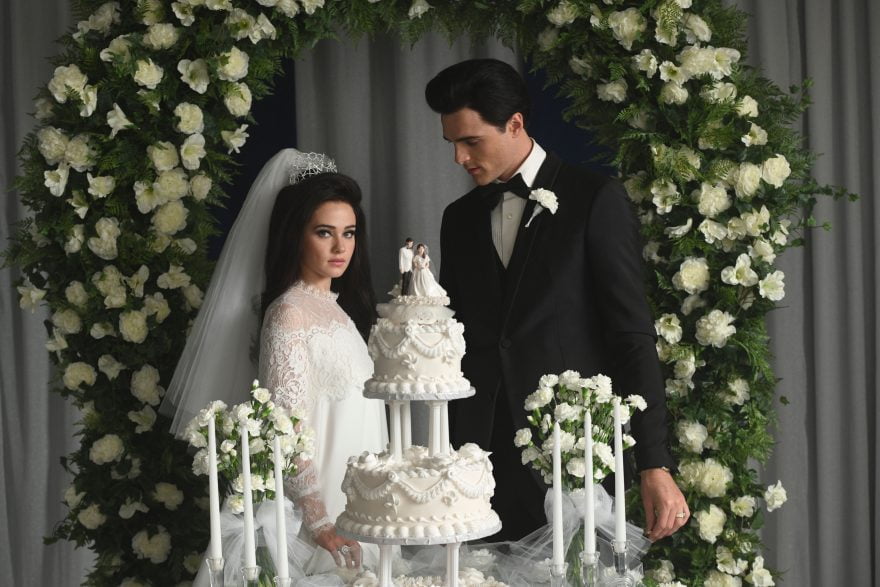
There’s a constant push and pull in play throughout Priscilla, which does a fine job recreating the Graceland experience far from the gates of the actual property. For all the creature comforts afforded to Priscilla (including handguns made to match any of her many outfits, a visual that’s both amusing and unnerving in equal measure), it’s never a place that feels like home, and Coppola might be one of the best filmmakers today capable of conveying that unshakable feeling of being out of place in ones environment. There are plenty of rose coloured moments of romance to be found here, but Coppola is always able to find a dramatic or subtextual counterpoint to those happier times. Coppola is always able to find quiet, slice of life moments that are able to perfectly rhyme with the bigger moments that the larger public already thinks they know, leading to a movie where there isn’t a single insignificant beat or an ounce of narrative fat; like watching years pass by in the blink of en eye. The tone throughout Priscilla is entrancingly bittersweet, which is appropriate since most viewers will know where this love story is headed before the film even starts.
For their parts, Spaeny and Elordi prove to be perfect collaborators when it comes to realizing Coppola’s vision. Spaeny nails Priscilla’s rich and wide ranging arc, from naive child bride to fed up and frustrated wife, always maintaining viewer empathy because her performance never wavers in tone or intensity. Despite the path life has taken her on, Spaeny shows Priscilla as being the same person deep down. The world changes along with her outlook, but Priscilla is still an honest person whose thoughtfulness was often mistaken for weakness. As her counterpart, Elordi makes the wise decision not to go for an outright impersonation of Elvis Presley, and instead plays the musical icon’s inner truth and soul; a caring person so caught up in fame and tabloid controversy that he’s lost the ability to tell when he’s being selfish, callow, jealous, and callous towards the only person that seems to have his best interests in mind. On their own and as a couple, Spaeny and Elordi deliver two of the best performances in any film this year, and certainly in any story involving these two historical figureheads.
While Coppola often gets accused by her critics for dabbling too much in existential ennui (something I admit I can agree with), the tone perfectly befits Priscilla. There’s a palpable sadness throughout Priscilla, but it’s not asking the viewer to weep for the bad times or cheer for the successes. It asks the viewer to take this relationship in its totality and for what it’s worth. There’s a certain degree of period nostalgia to be found in the film’s gorgeous visuals, but this look to the past is uniquely stoic on her part, instead allowing the performers to bring the emotions to life. It’s never showy in spite of the lifestyle depicted, like everything around the characters has had the volume turned down so you can hear their every word and observe every quiet thought. It takes something that could’ve been made into spectacle (and has in the past, most notably and recently by Baz Luhrmann) and instead looks for the quieter beats that most biopics like to internalize. Most people only know the surface of Priscilla’s story. This work will make them see the heart.
Priscilla opens in theatres everywhere on Friday, November 3, 2023.
