
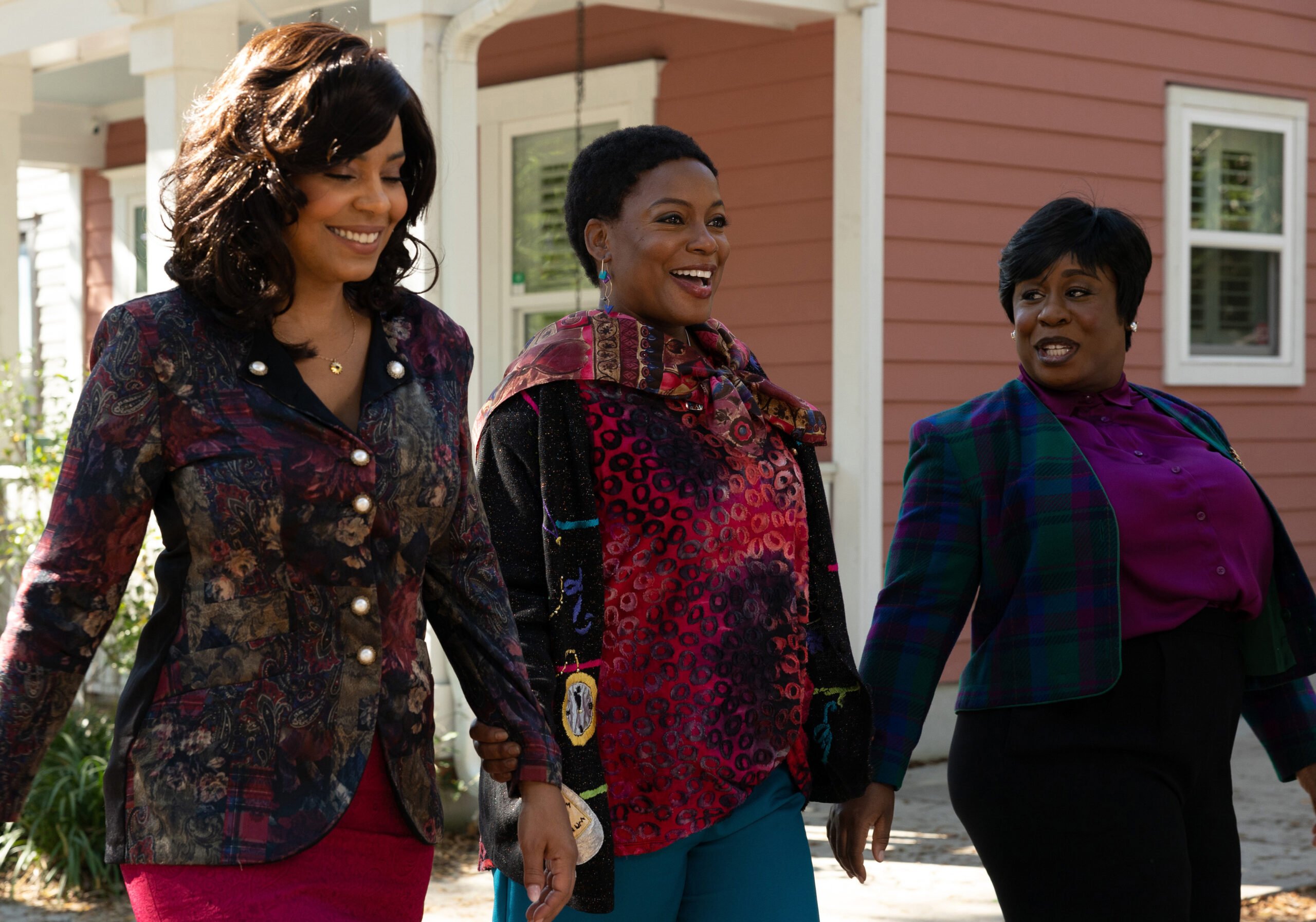
Like the title suggests, The Supremes at Earl’s All-You-Can-Eat is a well done bit of comfort food for the soul. It’s also a lot, bordering on too much to take in during a single sitting. It’s a familiar feeling old school melodrama about an unbreakable bond between a trio of life long best friends, which is fine, but in a bid to ensure everyone is as well rounded as possible, The Supremes at Earl’s All-You-Can-Eat races through a lot of plot and development without much time to let things breathe or sink in. In the moment, it’s overwhelming, but when given some time to reflect upon its decades spanning narrative there’s a good deal of joy and warmth to be remembered and savoured.
Since high school in the late 1960s, Odette (Aunjanue Ellis-Taylor, also really great in the recently released thriller The Deliverance), Clarice (Uzo Aduba) and Barbara Jean (Sanaa Lathan) have been inseparable. Dubbed “The Supremes” for the way they palled around and carried themselves within a room, they were famous for chilling and holding court at a greasy spoon that catered to a predominantly black community, run by the kindly, fatherly Big Earl (Tony Winters). But around the time of Big Earl’s death in 1999, cracks start forming in the bond of the friends, with one holding onto a secret about their health, another in a relationship where they suspect their partner is being unfaithful, and another struggling with alcohol dependency.
Adapted from Edward Kelsey Moore’s 2013 novel by veteran television director Tina Mabry and co-writer “Cee Marcellus” (a pen name used by filmmaker Gina Prince-Bythwood), The Supremes at Earl’s All-You-Can-Eat follows a familiar formula, with the goal of illustrating how the friends came together and what could cause them to fall apart. The story bounces primarily between 1968 and 1999 (with a diversion at one point to 1977) and does a fine job of showing how their past informs their present. It’s an effective structure for a feel good movie where the viewer is asked to bond with characters that will move them to empathy and sometimes test their patience, and Mabry effectively conveys the emotional beats that matter most with genuine heart and conviction.
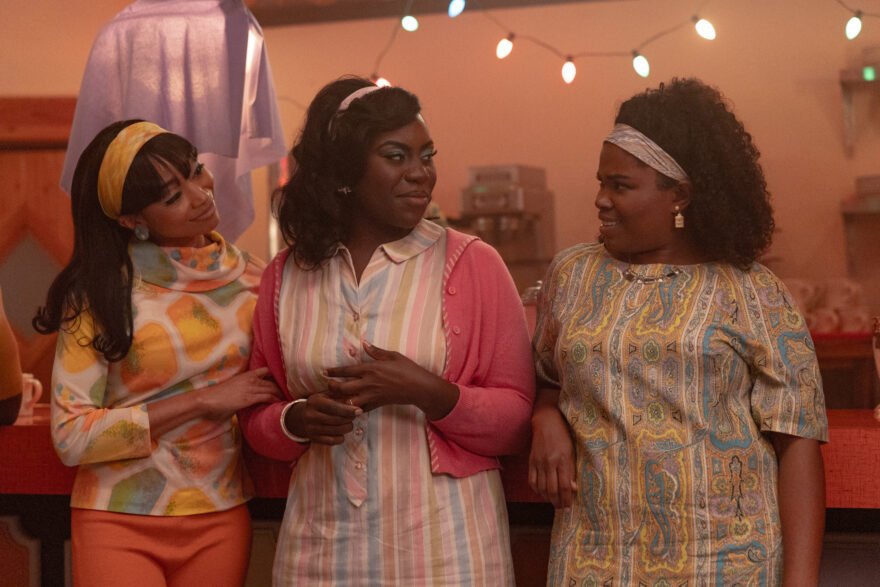
The sequences set in 1968s evocatively capture a fraught period in American history – both racially and globally, in what would be a watershed year for the country – and the vibes of a divided small town are effortlessly coaxed out of the settings by Mabry. In these sequences, the bedrock of the main characters is established, and wonderfully laid by the younger performers tasked with playing their teenage selves. Odette (Kyanna Simone) is headstrong young woman who dreams of being a nurse, but is branded by some unkind locals as a “crazy witch girl.” Clarice (Abigail Achiri) is a girly girl, piano prodigy. Barbara Jean (Tati Gabrielle) has been dealt a cruel hand by life, but Odette and Clarice step in to show her kindness and act as protectors and boosters. They deal with the whims of trifling men, racist yokels, unexpected life changes, and the then taboo nature of interracial relationships. There’s a familiarity to these sequences that recall similarly minded, female oriented projects, but Mabry shows that it still works wonders when trying to weave a dramatic tapestry.
At times, the shifting structure and big characters make The Supremes at Earl’s All-You-Can-Eat come off a bit like a stage play adaptation rather than a reworking of a novel, but that’s not the biggest problem here. The real issue isn’t the shifting narrative, but the way the film occasionally loses perspective or finds ways to distract itself. Initially, the story is framed as if it is going to be mostly from the direct perspective of Odette, but in practice a lot of the on screen action and consequence is experienced by Barbara Jean, who I guess narrowly edges out her friend as the person who’s had a harsher go of things (but that’s an endlessly, pointlessly debatable point). Clarice, the strong centre of the group, is often shunted to the background, only popping up for the character’s biggest scenes.
On their own, each of the characters in The Supremes at Earl’s All-You-Can-Eat are smartly realized and believable, but instead of settling upon a way to creatively prioritize any of them at a given point, Mabry’s film becomes a pile on where everything crashes into each other because there’s such a narrow space to fit all of this into. At a shade over two hours, The Supremes at Earl’s All-You-Can-Eat is a substantial movie, but with a few cuts here and there to trim the bloated side stories (Big Earl’s crazed widow who’s trying to hilariously embrace divine judgment, Julian McMahon as a former flame who has blown back into town) and a greater emphasis on a balance between the core trio, this could’ve been a lot stronger.
But just like diner grub shared among friends, The Supremes at Earl’s All-You-Can-Eat delivers a full plate with a side of conversation. There’s too much going on, and at times it can feel overwhelming, but it leaves one feeling full and satisfied by the end. It captures all the love, tragedy, joy, and sorrow that goes hand in hand with growing older, and it will effortlessly stir those emotions in viewers. That’s why we go to movies like this – and diners – in the first place.
The Supremes at Earl’s All-You-Can-Eat streams on Disney+ in Canada and Hulu in the U.S. starting Friday, August 23, 2024.
