
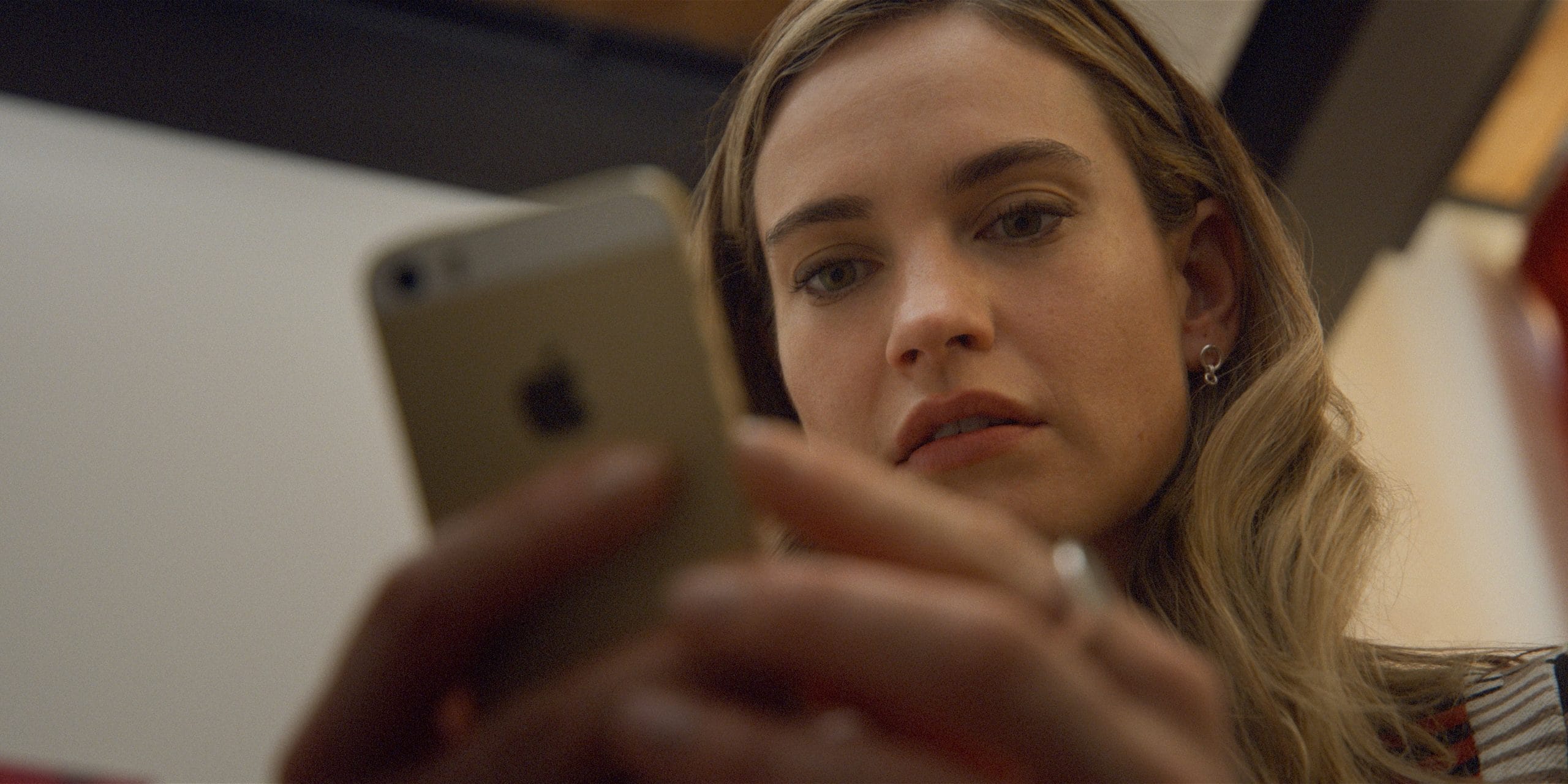
For every admirable point that the hollow tech-world biopic Swiped tries to make about being a woman in a male dominated field, the film gets bogged down in trite, inauthentic storytelling shortcuts that belittle the film as a whole. A loose, unauthorized (?) look at the rise of Bumble CEO and founder Whitney Wolfe Herd, Swiped never settles on a cohesive tone and wallows in unbearably overwritten and tossed off exposition that takes up too much space and energy. In spite of a few funny throwaway moments and an overall admirable attempt to expose sexual discrimination in the tech industry, Swiped falls flat by never once feeling organic and well paced enough to be believable. While I’m sure many of the emotions and overall scenarios depicted in Swiped actually occurred, there’s absolutely no way it played out in a fashion as theatrically forced as this.
At the start of Swiped, Utah native Whitney (Lily James) has just arrived in Los Angeles and is keen to start up an app that helps humanity (something to do with orphanages that isn’t well explained), but finds out just how hard it is to get hard living, money hungry tech bros and investors to listen to her. The only person willing to give Whitney the time of day is Sean Radd (Ben Schnetzer), who tells her that if she wants to change the world for the better, she needs to have some capital behind her first. Whitney takes a job at Sean’s think-tank as a marketing director and promptly forgets about any of her altruistic aims. The film never brings them up again after the first fifteen minutes, immediately shifting gears into making its own protagonist into just another entrepreneur.
Whitney becomes a key figure in the formation of Tinder, the now ubiquitous dating and hook-up app that saved Sean’s start-up from irrelevance. An appreciative Sean makes Whitney a co-founder of the brand, although the company never acknowledges her contributions properly whenever doing press. Whitney also starts up a relationship with Sean’s best friend, hanger-on, and newly minted co-founder (even though he didn’t really go anything except show up to work), Justin (Jackson White). That relationship quickly turns sour, with Justin turning out to be an obsessive, petty, psycho that Sean refuses to take action against. After trying for too long to remain professional and make things work at Tinder, Whitney is forced to leave. She signs an NDA, which lands her a settlement, but Sean and his cronies are then free to say whatever they want about her with almost total immunity because she’s unable to clap back. With her career all but ruined, a lifeline appears in the form of a foreign investor (Dan Stevens, once again taking on a role that allows him to have a funny accent and ridiculous haircut) who gives her the chance to start up a new, female friendly dating app to rival her former employers.
The pacing of Swiped – directed and co-written by Rachel Lee Goldenberg (Unpregnant, the Valley Girl remake) – is a complete mess. Goldenberg and co-writers Bill Parker and Kim Caramele never decide where to put their emphasis. Do they want their story to be about the building of a brand, a woman overcoming the odds, or a more interesting story about workplace discrimination and frat boy culture in the tech industry? Swiped also can’t discern if it wants to be a serious drama, a wacky workplace comedy, or a heady satire, meaning viewers are often given emotional whiplash. One moment, Whitney could be dealing with some hard and depressing shit, only to have some kid randomly and apropos of nothing haul off and punch a guy in the nuts seconds later. The main heads of tech companies are portrayed as both serious threats to Whitney and complete, clueless, comedic goofs. For most of Swiped, I was completely unsure what type of movie this was supposed to be outside of a biopic that’s in such a hurry to hit all of its beats that it forgot how to assemble everything into a usable package.

These massive tonal shifts – which range from childish slapstick to deadly seriousness – leave the cast completely adrift. James and White flounder throughout, going along with the whims of the script and only doing what is called for in the moment, never crafting performances that cohere as a whole. It’s not their fault, it’s the material. Schnetzer fairs best of the bunch because – flaws and all – his start-up golden boy plays the closest thing this film has to a fully believable character. Stevens, however, might be in need of a career intervention or a better director, as his penchant for adopting silly voices and outlandish outfits in movies as of late works against everything Swiped is setting out to say about money men in tech, especially when a late film pivot threatens to undo all of Whitney’s hard work for a second time.
Nothing unfolds in a believable manner. It unfolds in Hollywood fashion; where the viewer is never aware of how much or little time has passed between events and the filmmakers hope no one questions the illogical nature of the timeline. Scenes where Whitney has to deal with the fallout of her departure from Tinder are some of the best in the film, and whenever Goldenberg and company speak to their protagonist and her co-workers’ struggles to work within a sexist power structure, Swiped is at its best and most honest. But everything else around these beats is so patently forced, inorganic, and clunky that Swiped undermines its own best practices. Swiped wants to be a serious indictment of toxic workplace culture and the ways the tech industry can ignore the contributions of women, but it also wants to be a feel good comedy about a girlboss rising to power. There surely has to be way to make these two things square up, but Goldenberg never finds it.
From the top and again at the conclusion, Swiped is quick to point out that while it’s inspired by true events, it’s actually a work of fiction and that Herd wasn’t involved with the making of the film, pursuant to the aforementioned NDA. Ultimately, the film can only push so hard in certain directions without warranting a lawsuit, and as such, Swiped pulls a lot of punches when it should be swinging for knock-out blows. I don’t think there’s much in Swiped that isn’t already public knowledge, carefully parsed and presented in a way that both makes Herd look good (something that can be debated in the film’s final act) and avoids a lawsuit from those who made her life a living hell. While the film might skirt legal action, everyone should be thanking their lucky stars that people can’t sue over a movie not being very good.
Swiped is streaming on Disney+ in Canada and Hulu in the U.S. starting Friday, September 19, 2025. This film was screened as part of the 2025 Toronto International Film Festival.
