

Sepideh Farsi’s raw, intimate documentary Put Your Soul on Your Hand and Walk tragically illustrates the increasingly dire conditions within Gaza through a long distance conversation carried on across a year’s time between the filmmaker and her subject. Farsi’s work here is purposefully devoid of stylistic polish and filmmaking trickery, allowing for maximum impact and the sort of realistic human interaction that makes the viewer feel every ounce of hope, sadness, and desperation experienced by Palestinian photographer Fatma Hassouna along the way.
Unable to return to her own home country of Iran as a result of her work and opinions, Farsi (who currently lives in France) understands the feeling of displacement well. Put Your Soul on Your Hand and Walk is borne from Farsi’s desire to interview those currently fleeing from the current war in Gaza. During her travels and long distance video chats, Farsi is put in touch with Hassouna, a young woman who refuses to leave Palestine. Since Farsi can’t travel into Gaza herself, the director conducts a series of lengthy video calls with Hassouna, often having to contend with poor (often military blocked) connections and the ever present noise of drones, jets, and helicopters in the background of their conversations.
Put Your Soul on Your Hand and Walk (which gets its name from something poignant Hassouna says during one of their conversations) is a stark portrait of resilience and pride. Even in her darkest moments, Hassouna (who’s also a poet and songwriter on top of being a photographer) speaks with great affection for her homeland. She has little to lose, and feels the need to document the decay, famine, violence, and atrocities she witnesses on a daily basis. Even after losing over a dozen family members in various Israeli bombings, some of them young children, Hassouna’s strength is unwavering. Although malnutrition, exhaustion, and grief take their toll throughout Put Your Soul on Your Hand and Walk, Hassouna maintains her dream of wanting to study photography outside of Gaza, seeing her survival as an act of resistance and joy.
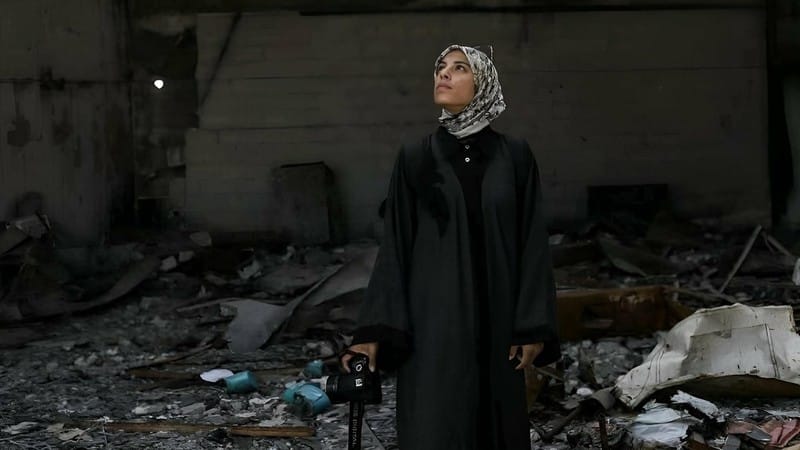
There’s no artifice to Put Your Soul on Your Hand and Walk, which stays true to the conversations had between the filmmaker and subject and presents them in unvarnished fashion. Phone and laptop screens are smudged and dirty, calls drop out or freeze, and sometimes the conversations can be briefly unintelligible; each stuttering frame causing a lump of fear to catch in the viewer’s throat. But Farsi is able to convey Hassouna’s warmth, gregariousness, and strength with such purity that the film functions like the viewer is trying to communicate with a loved one of their own in a similar situation. The technical hardships are nothing in comparison to what Fatma goes through and documents on a daily basis. Farsi appreciates the work Hassouna does and highlights her photography in striking ways throughout the film, but Put Your Soul on Your Hand and Walk also devastatingly captures what it feels like to try and connect with someone in a war zone; always fearing the worst and desperately wanting to know that everything is okay.
Nothing turns out okay by the end of Put Your Soul on Your Hand and Walk. The day after Farsi’s film was accepted to screen at Cannes this year, Hassouna and much of her family were killed in an Israeli airstrike. This leaves Farsi’s work as tragic reminder of those lost in the current Israeli occupation of Palestine, but also a celebration of a person who took great pride in their homeland and family to the very end. Hassouna wasn’t a fighter, but instead an artist and documentarian of her own. The film remembers Hassouna’s contributions to a vital form of civilian journalism coming from the region. Hassouna’s photographs and conversations with Farsi speak to an even greater sense of loss that needs to be preserved for generations to come.
Put Your Soul on Your Hand and Walk was screened as part of the 2025 Toronto International Film Festival. It screens again in Toronto as part of the 2025 Toronto Palestine Film Festival on Saturday, September 27, 2025 at TIFF Lightbox at 5:15 pm. It screens in Montreal at Festival du Nouveau Cinema on Thursday, October 9 (6:00 pm, Cinéma du Parc) and Sunday, October 12 (5:00 pm, Cinéma du Parc). It will begin its proper theatrical rollout starting in November.
