
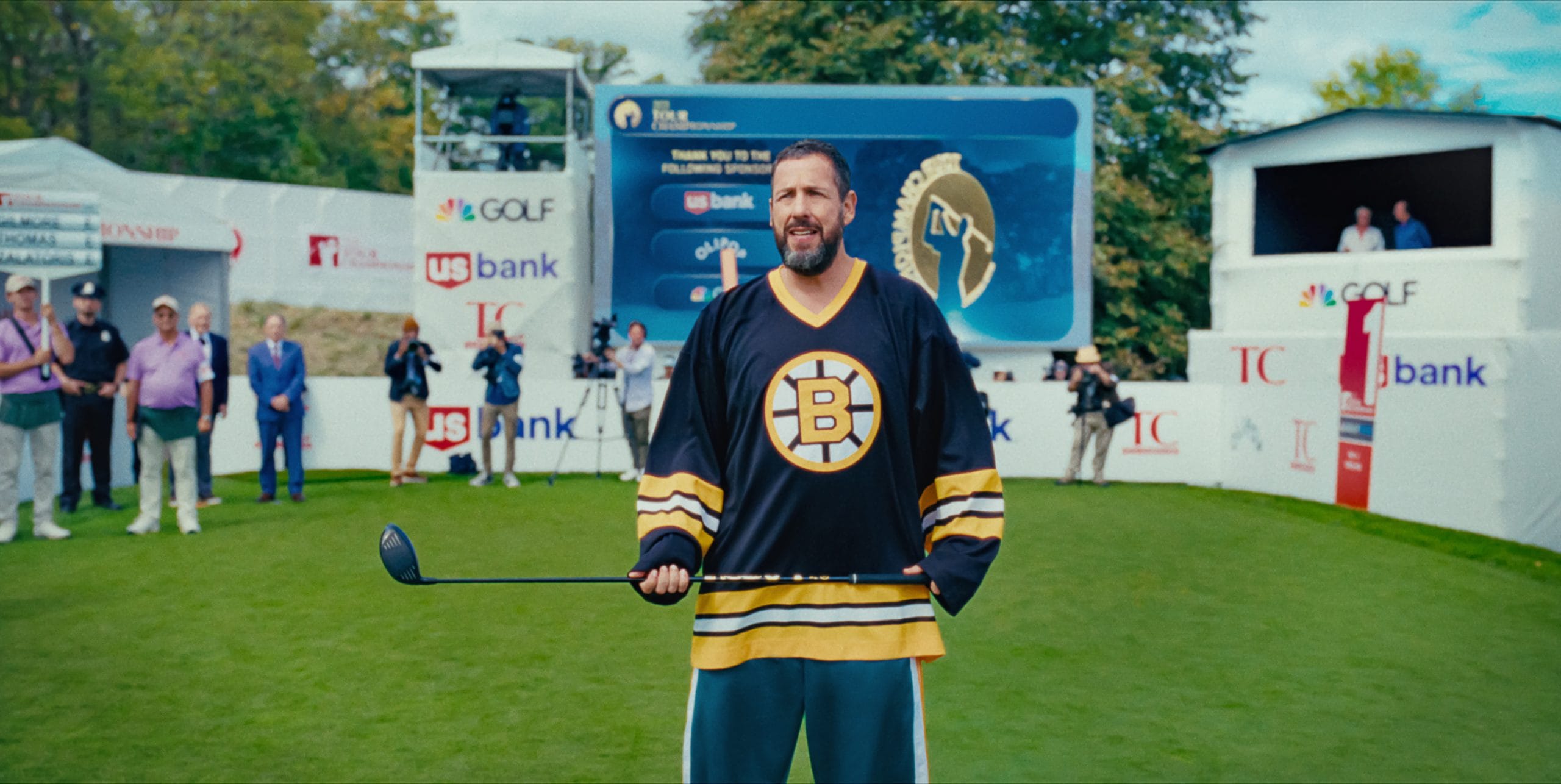
While the sophomoric comedy Billy Madison first introduced moviegoers to the unique, at times divisive leading man stylings of former Saturday Night Live cast member Adam Sandler, it was his second major starring role in the smash-hit sports comedy Happy Gilmore that provided the actor with a rocket to the A-list, and has given him an enduring (not always endearing) presence on screens big and small since. Now, just a shade under thirty years later, Happy Gilmore 2 arrives, and the more things have changed, the more they stay the same. While not as deliriously anarchic as its predecessor and disarmingly more reserved, Happy Gilmore 2 grows up a bit, but still delivers a satisfying underdog story that marries Sandler’s older project to his newer, more introspective, dad joke adoring side.
Happy Gilmore 2 is one of those sequels that changes the game drastically from its opening moments. After a healthy career as a happily married pro golfer (to sweetheart Virginia, played again by Julie Bowen) with four boys and a girl back home, a sudden tragedy sparks a downward spiral for Happy (Sandler). He stops playing golf, hits the bottle harder than he ever did the ball, goes broke, loses his beloved grandmother’s house, and works a dead end job at a supermarket. When he learns that his daughter (Sunny Sandler) has an opportunity to study ballet in Paris, Happy attempts to clean up his act, get back on the course after a decade away and at the age of 58, once again trying to earn some cash to help out someone he loves.
The sad and melancholy opening to Happy Gilmore 2 might throw some for a loop out of the gate, but it won’t be long before the gags start coming back in full force. Once again casting a lot of his own family members, giving plenty of his closest friends and collaborators cameos, and paying homage to cast members from the original who’ve sadly passed in the intervening years, Happy Gilmore 2 isn’t only a film for the fans, but an earnest thank you to everyone who’s helped Sandler keep his career for the past 40 years. Working on the script with frequent collaborator Tim Herilhy and alongside director Kyle Newacheck (who oversaw Sandler’s Murder Mystery), the star blends past and present in a way that isn’t always hilarious, but is relaxed and endearing. The arc of Happy this time out is a lot closer to the one Herilhy and Sandler crafted for The Wedding Singer, but the formula still works.
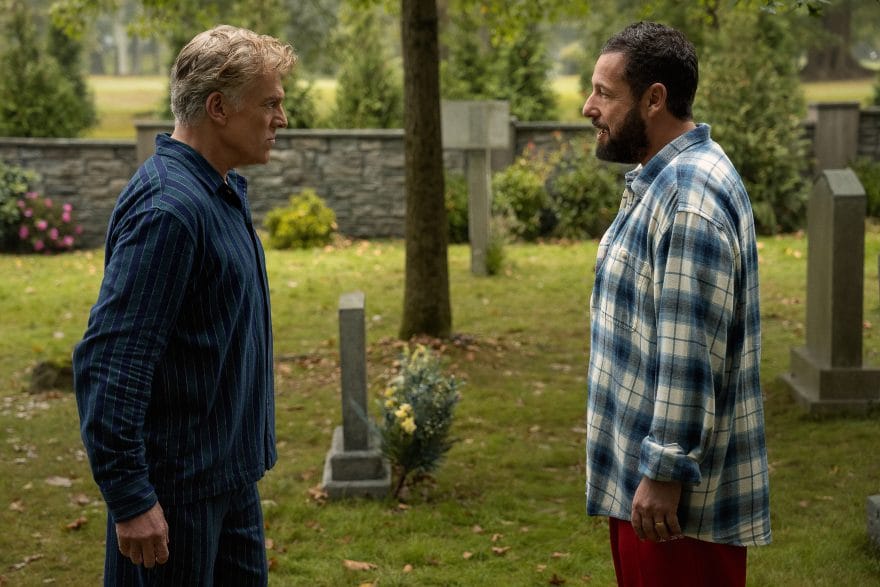
Other than Happy trying to deal with his longstanding anger management issues and alcohol dependence (exemplified with a running visual gag that can make any household object into a flask), the conflict here revolves around Gilmore rebuffing the overtures of a halitosis ridden energy drink magnate (Uncut Gems co-director Benny Safdie, having an absolute blast) who’s trying to start up a new “extreme” golf league. There’s some light commentary in here about the upstart LIV golf tour, commercialism in pro sports, and performance enhancing athletic loopholes, but it’s mostly just an excuse to give Happy some new, risible villains to take down a peg or two (including Haley Joel Osment as a cocky rival). As for Happy’s most memorable nemesis, Shooter McGavin (a returning Christopher McDonald, who’s as great as ever), he’s recently resurfaced after twenty-nine years out of the spotlight (for… reasons) and also in need of getting his life back on track. This is a film that’s once again about talented people who constantly get in their own way, not some kind of greater social or satirical commentary.
There are callbacks aplenty in Happy Gilmore 2, but most of them don’t work as well as the fresher material. Far too many times, Newacheck, Sandler, and Herilhy stop the movie dead in its tracks to simply nudge the viewer into remembering things that already happened and were done better the first time out. That, coupled with a propensity for sometimes distractingly bad visual effects, can drag things down from time to time, but the new additions to Happy Gilmore 2 make up for the indulgent trips down memory lane. Sure, a great deal of Happy Gilmore 2 comes from a sense of nostalgia that viewers will bring to it, but the recalculated tone and new cast additions give the film some additional spin on the ball.
Next to Safdie, the biggest show stealer out of the new cast members is Benito Antonio Martinez Ocasio, better known as Bad Bunny, who displays great comedic instincts as Happy’s soft spoken, well meaning new caddy, a bus boy that was routinely picked up on at work. Philip Schneider, Ethan Cutosky, Maxwell Jacob Friedman, and Conor Sherry have a great dynamic as Happy’s uncouth, juvenile, hockey fight loving adult sons. Sandler’s other performing daughter, Sadie, has a nice role as a kind woman who shows Happy some much needed kindness in his court mandated rehab program (which is led by yet another returning character, played by Ben Stiller). These performers and plenty of other stars popping up for brief appearances – including golfer John Daly, playing himself and skewing his own “bad boy of golf” image as a burnout living in Gilmore’s garage – are having fun playing around in Happy’s sand trap, and the joy is obvious.
Sandler comedies are often only graded by critics on either a sliding scale or a basic level of dismissal. His style of humour isn’t for everyone, and it never has been. But if one were to grade Happy Gilmore 2 evenly and down the middle as a sequel, it would be great, but not exceptional. Maybe time has made some want to see a sequel to Happy Gilmore hit a bit harder than this, but time usually makes us all a bit softer. Sandler leans into his age here and turns this sequel into more of a hangout movie than some kind of grandstanding comedic spectacle. Like the first film, this kind of thing isn’t rocket science or high art, but much like Happy’s iconically ludicrous swing, it gets the job done.
Happy Gilmore 2 streams on Netflix starting Friday, July 25, 2025.
