

The Smashing Machine is a smartly made movie that doesn’t attempt to intellectualize a sport where people pummel each other for money. Instead of looking at melodramatic moral breakdowns, devastating injuries, and navigating addictions, writer-director Benny Safdie approaches the world of MMA and the families of the sports’ fighters from the perspective of those who live the life, not those commenting on it from the outside. Sure, there’s plenty of melodrama, in-ring beatings, and vices to list off, but The Smashing Machine is far more human and less Hollywood than a lot of its more crowd pleasing sports movie brethren. It’s still not much more than a really well done sports movie, but Safdie’s storytelling ability and a transformative performance from leading man Dwayne Johnson ensures that The Smashing Machine takes the most interesting road possible leading from an obvious point A to an obvious point B.
Safdie (flying solo after working with his brother Benny on the likes of Good Time and Uncut Gems) finds his inspiration in the life and career of accomplished, legit freestyle wrestler and MMA fighter Mark Kerr, taking cues from a documentary made about the former champion back in 2002. Johnson, wearing some convincing prosthetics, plays Kerr at the height of the fighters’ career from 1997-2000, back when entities like Pride and UFC were in their infancy. Although he was a capable fighter pegged as a beast from his first professional bout – based out of Phoenix, Arizona, but originally from Toledo, Ohio – Kerr frequently had to make trips overseas to make any money from the fight game, with the most profitable offers coming from Pride’s home base in Japan. The constant travel, the toll fighting takes on his body, and evolving substance abuse issues tied to pain management make an impact on Mark’s relationship to his wife, Dawn (Emily Blunt). They have great love for one another, but Dawn has trouble breaking into Mark’s closed off mind, and he sometimes sees her presence as a liability, both in terms of his in ring performance and trying to maintain sobriety outside of it.
It’s not too surprising that The Smashing Machine builds to a climactic sequence where Mark has to battle his demons in order to succeed, but the steps Safdie takes along the way to depict that journey are more nuanced than these types of movies get. It’s fascinating to see glimpses of a sport that now feels ubiquitous and inescapable going through a variety of growing pains (including a fascinating section where Kerr loses a key fight because a referee couldn’t remember a recent rule change), and observing the ways that fighters like Kerr had to constantly reinvent themselves to keep up. An early scene where Kerr is in a doctor’s office waiting room chatting with an older woman who finds MMA barbaric is in place to talk about the morality and perception of the sport, but after that groundwork is laid in swift fashion, The Smashing Machine shifts into full on character piece territory.
Safdie keeps the primary cast of The Smashing Machine to a bare minimum, ensuring that the characters who get the most screen time are impeccably fleshed out. With cauliflower ears, a face like a an overly tanned bulldog, and an unexpectedly soft voice and humble demeanour, Johnson fully embodies Kerr on screen, delivering a career best performance that’s every bit as good as people have been saying it is. Johnson turns down his star power here, but keeps a healthy amount of charisma when portraying Kerr. While not a perfect person, Johnson portrays Kerr as a unique MMA ambassador and trailblazer that has gone overlooked in recent years. Johnson’s Kerr approaches every situation like it’s a two-sided conversation, even if he doesn’t like what the other person has to say.
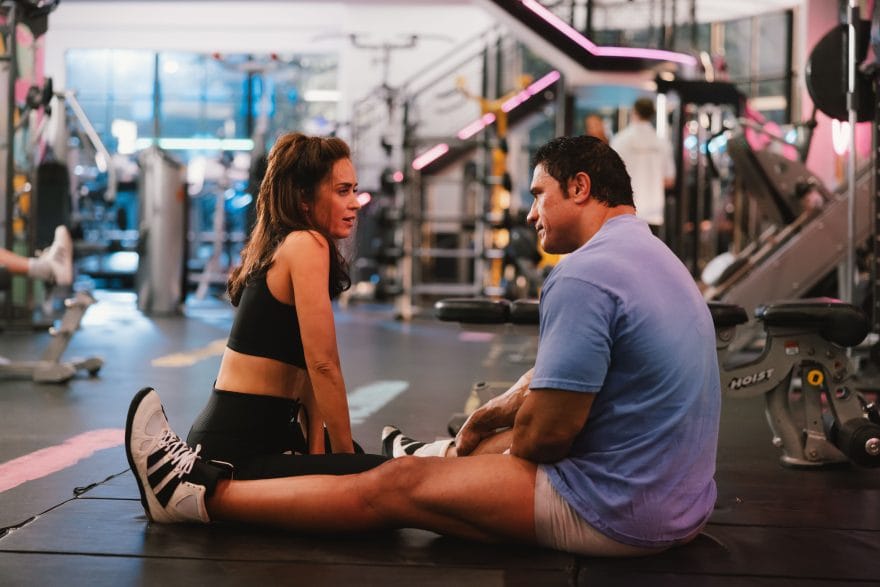
That’s where Blunt and Ryan Bader, a real life fighter portraying fellow MMA legend Mark Coleman, come in to give Johnson solid sparring partners. Showcasing a much different and intimate kind of chemistry than they were able to display together in Jungle Cruise, Blunt and Johnson look and sound every bit like a couple that has been together for quite some time. They have an effortless shorthand and rapport, whether the characters are sharing a tender moment or a brutal shouting match. Blunt’s Dawn shows concern for her partner, but never devolves into a stereotypical depiction of a strong, supportive woman. She’s her own person with her own problems. And in his first major role, Bader is highly impressive as Kerr’s closest friend and sometimes in-ring rival, a family man who’s keenly aware of the dark paths the fight game can lead someone down. He feels like a natural at this sort of thing.
Stylistically, The Smashing Machine is just as much of a knockout. (Pardon the pun, but the descriptor feels apt.) Although it’s set at the end of the twentieth century, the direction of Safdie and cinematography of Maceo Bishop make the film look like a product of the 70s or 80s. The period details are stunning, mostly because the time frame is clearly the 90s, but the spaces being inhabited look like they haven’t been touched up or redesigned for twenty years, making it seem like the still growing sport was something often relegated to back rooms and banquet halls in its early years. Safide and Bishop’s use of VHS cameras during some of the fight sequences add a degree of grit and authenticity that marries nicely with other sequences that are shot with traditional 16mm and 65mm IMAX film stocks. The jazzy score from Nala Sinephro (who pops up for a cameo to sing “The Star Spangled Banner” before a key fight) adds to the low key, lived in atmosphere Safdie is going for. It’s a film inspired by a documentary that nicely emulates such a style, while also telling a more fictionalized version of events.
The Smashing Machine very much fits into the classic sports movie framework where someone rises, falls, and learns to get back up, but Safdie approaches such a classical narrative with an assured, relaxed sense of pacing and knowing confidence in the audience’s intelligence. While the unfamiliar will likely learn a lot about the roots of MMA from The Smashing Machine, Safide isn’t overly concerned with the minutiae of the sport, but rather the inner lives of these characters. It’s a little bit about the drive to be a champion and to maintain such a demanding lifestyle, but it’s mostly about their differing outlooks on life, and how that defines them more than successes and failures. Not much of The Smashing Machine is ever in doubt (especially if you’re familiar with any of the real life people involved), but Safdie’s film remains an engaging human drama about misunderstood people.
The Smashing Machine opens in theatres everywhere on Friday, October 3, 2025. It was screened as part of the 2025 Toronto International Film Festival.
