

In Jamal Burger and Jukan Tateisi’s documentary Still Single (which opens in Toronto at TIFF Lightbox this weekend), legendary, visionary, and still relatively young culinary artist Chef Masaki Saito opens up his personal and professional life to a wider audience; one that might not be able to access his creations up close.
Born and trained in Japan, Chef Saito made his way from a successful career in New York City to Toronto, where he would establish Canada’s first two star Michelin recognized restaurant, Sushi Masaki Saito. This accomplishment wasn’t even anything new for Chef Saito, whose previous restaurant in New York was also awarded two stars. His Edomae-style of crafting sushi is somewhat unique to find outside of Japan, and his omakase dinners will set patrons back upwards of $800 a person. But most who can afford the luxury of dining at Chef Saito’s Yorkville establishment will often say that it’s worth every penny.
Burger and Tateisi embedded themselves with Saito and co-owner William Cheng for the better part of two years, getting a glimpse not only into the operations of Saito’s restaurant, but also the chef’s personal life and innermost feelings. Perhaps it’s not a surprise given his age (which many people remark upon with awe), but Saito isn’t above partying hard, hitting a karaoke bar, downing some drinks, and having a good time. His cholesterol level is high, as is his overall stress level. His attitude can often be seen as cold, but he’s hardly humourless, and the loyalty he shows to his closest friends belies an obvious generosity. He admits to only ever feeling half happy, even with the adulation of many in and around his orbit. He’s also, as the title suggests, still single, and that largely seems by design.
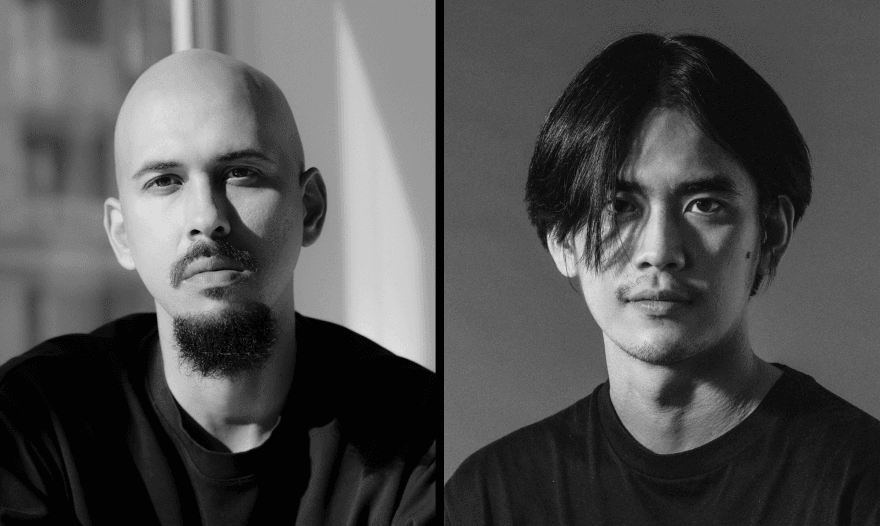
“Behind anything great, there’s a human, and where there’s a human, there’s a story,” Burger says about Still Single during an interview alongside Tateisi and Chef Saito, conducted a few days before the film’s world premiere at the Toronto International Film Festival this past September. “Getting to know the human who makes this restaurant possible was the most intriguing part of making this film up front.”
“Being a two star Michelin chef isn’t easy, for sure,” Tateisi adds. “And with that, there’s a certain image that people have of what that kind of person is. I think Chef Saito runs against that image model.”
The idea of being filmed all day was one that Chef Saito approached with some understandable degree of trepidation, and he never fully understood what Still Single was going to be until he saw how Burger and Tateisi spent their time in and around his operations.
“I didn’t know what to expect and what this would become. They spent about two and a half years following me, and I still didn’t know,” Chef Saito says with a nervous chuckle. “And while it was going, I was still stressed about it. It was too much for me. I’m not used to people following and following and following me wherever I go. And when it’s finished and I see what they did, it was a big surprise for me, because I see what they did and now, it’s a very good story. It’s beautiful. I learned a lot, and now I see it as a good experience in my life.”
To be fair, and like most documentary filmmakers, Burger and Tateisi didn’t fully know where things were heading, either, until they sat down and looked at what they had observed over the two year filming process.
“You have the footage, you translate it, and you synthesize what these piece are saying, and you keep going through these layers of expression until you reach the final thesis of it all,” Burger says of the editing process for Still Single. “Hindsight is always twenty-twenty, and the first thoughts we had of what this film could be still exists, but over the time spent with Chef Saito and looking through what we had, everything became a lot more clear and we found the journey of the film.”
For Tateisi, Still Single came into sharper emotional focus during a pivotal point in Chef Saito’s journey that the filmmakers witnessed unfolding in real time: a curious, unexpected emotional blow delivered by one of their subject’s closest and dearest friends.
“Things really change at [a very personal point in the film],” Tateisi explains about one of the documentary’s most emotional moments. “Before that, we’re mostly thinking about his character as being this humble, interesting guy with a good deal of success and an interesting life. But when you see someone go through something profound, we really start looking at things like love and friendship and what lies behind those things.”
Another level of difficulty was added to the production of Still Single as a result of the global nature of Chef Saito’s restaurant. Saito and Cheng source ingredients from all over the world, primarily from Japan in a bid to retain a degree of authenticity to the sushi being served. Saito and Cheng can tell by taste how fresh a fish is, and will know immediately when something is off just by looking at it or feeling the temperature. But viewers will also learn about how important good quality rice is just as important to great sushi, and the inner workings of soy sauce pressing. A film about Chef Saito would need to be as detail oriented as its subject.
“There’s so much work that goes into what Chef Saito does,” Burger begins, as he explains what it was like trying to film on different continents and keep up with the intricacies of the restaurant’s business. “There are so many moving parts that we as filmmakers have to keep up with. The restaurant is here, but its starts in Japan and the story is always deeply tied to Japan. And you have people who work with him who are travelling all over the world, and they have their own ideas, jobs, and lives. There’s a lot of work that goes into following along with that, but it’s eye opening. Saito’s really bringing Japan to Canada, and that was really special to see.”
“For example,” Tateisi adds, “just looking at the ingredients he uses can be overwhelming. The fishes he uses are things you could get in North America, but he brings them from Japan, and as filmmakers we have to help explain why he does that and the significance of it. And when Chef Saito and his staff explain that, it makes sense to me”
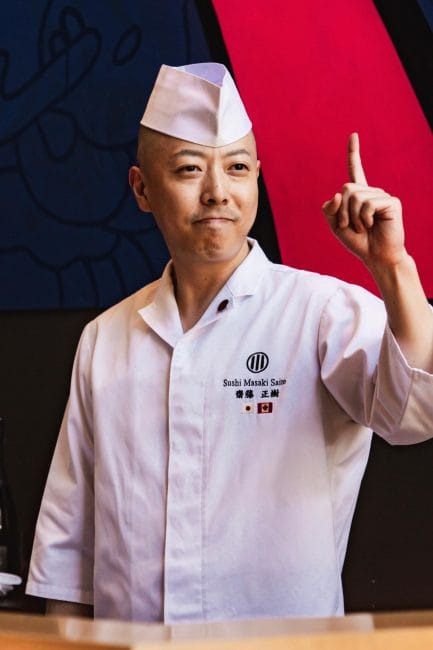
Beyond the obvious luxury that goes into his sushi, Chef Saito also has to be a bit of a party host, capable of creating an entire vibe that can match a number of different personalities and needs at the same time. A great deal of the ambiance at Sushi Masaki Saito comes from a blend of presentation, showmanship, and ritual, all of which need to come through on the plate, as well as on the dining floor.
“My style is just feeling,” Saito says when trying to explain the art of plating his creations. “I never learned how to present food from a teacher. Sometimes when I see teachers plating something and showing technique, I don’t like it. It doesn’t feel right to me. There’s no feeling to it. There has to be creativity, and some collaboration, also. Deciding which plate with which ingredients is about feeling to me. It’s hard to explain, and it’s also hard to learn. It’s having an extra sense. What do you think about the plate? Do you feel hot? Do you feel cold? It’s hard to explain, but you just know it when you feel it.”
Chef Saito and the filmmakers agree that people go to one of these restaurants not only for the food, but also for the setting and service, something that can be disrupted by the presence of cameras. The feeling that Chef Saito strives to create in his restaurants (including the recently opened LSL, a highly successful collaboration with fellow chefs Didier Leroy and Christian Le Squer, also located in Toronto), is one that’s relatively calm, but also open to interpretation. Some people come to Sushi Masaki Saito to have a romantic dinner, while others want to boisterously celebrate a major accomplishment. Burger and Tateisi always had to be cognizant of both the needs of Saito and his staff and the patrons paying to be there.
“Saito and his team were so generous with their time and having us there, and even went as far as approaching diners for us and asking if it was okay for us to be there, filming their food and seeing what they ate,” Burger says about the filmmaking team’s desire to be open and transparent with those around them and their intentions. “This is a place that’s very intimate in its approach. People are celebrating anniversaries, birthdays, and a lot of pivotal moments in their lives, and it’s a credit to everyone in the film and around it that they let us into their lives just as if it was another normal day. We would immerse ourselves in the everyday operation during the week, and sometimes we would come back to shoot on the weekends to watch everything in execution while the restaurant was closed, and then we would merge the two. Some of this was shot-listed, but a good portion of it was just captured from being there, feeling that feeling that Chef Saito talked about, and never knowing what was going to take place.”
“A lot of what we did came down to just being respectful of people and their space,” Tateisi explains. “You can’t see any boundaries, so you have to be careful and try to understand where they would be. But by feeling the atmosphere around you, you can find that boundary that you shouldn’t step over.”
“Like the way Chef Saito creates his food, a lot of this process was instinctual and intuitive,” Burger concludes about the feeling out process. “The first time we entered Saito’s restaurant was as customers, not as filmmakers, so we were able to see how intentional he was when it comes to crafting and cultivating an experience for customers. That was a big starting point, getting to experience that side of it before we started shooting. We learned how to love the food and then examine why we loved it the way we did, and also learned how important it is to protect that experience for the customers. We always moved with respect, whether there were customers there or it was just us. We always wanted to honour the tone that’s being struck by Chef Saito and his staff. That’s the proverbial sandbox we were playing in, and the feeling we tried to intentionally preserve. It’s not just the food. You’re not just eating when you go to Saito’s restaurant, you’re experiencing Japan, you’re learning something, even if you don’t realize it. You’re seeing the mastery of a craft in real time.”
Still Single opens at TIFF Lightbox in Toronto on Friday, December 5, 2025. The 6:45 pm screening on Saturday, December 6 will feature a live Q&A with Jamal Burger and Chef Masaki Saito, with co-director Jukan Tateisi joining virtually.
