

No one does disaster and tragedy quite like Paul Greengrass, and while The Lost Bus isn’t the filmmaker’s best work, it certainly reaffirms his status as the king of depicting large scale suffering. That’s not meant as an insult, as detail oriented Greengrass typically imbues his films with a wealth of emotion and technical complexity. Although he’s probably best known by audiences for his work on three of the Jason Bourne movies, films like Bloody Sunday, United 93, Captain Philips, and 22 July showcase Greengrass’ unparalleled talent at examining everyday people under extreme, frequently deadly pressure trying to survive forces beyond their control. The Lost Bus, based on true events that unfolded during the devastating 2018 Camp Fire in California, is no exception, and while this entry into Greengrass’ filmography has a bit more Hollywood theatricality in its later stages than the gritty realism the director is known for, it’s still a harrowing experience to sit through.
The Lost Bus starts the day before the historic wildfire, around 4 pm on Wednesday, November 7, just as school bus driver Kevin McCay (Matthew McConaughey) is heading home after another unexceptional day at work. His mind isn’t on his job, but he needs extra shifts to care for his ailing mom (Kay McCabe McConaughey). Kevin’s teenage son, Shaun (Levi McConaughey), can’t stand him and wishes he was living with their mom. Shaun insists he’s sick and can’t go to school, but Kevin thinks it’s all a ruse. Amid all the personal tensions in his life, Kevin goes to work the next day and sees smoke and flames billowing from a the bone dry highlands nearby, which haven’t seen a drop of rain in over two-hundred days and was sparked by crumbling power company infrastructure falling into disrepair. High winds spread the flames across the parched ground quickly, forcing spur of the moment evacuations from the surrounding areas. With traffic out of surrounding communities at a standstill, Kevin’s bus is the only vehicle available to pick up a teacher (America Ferrara) and 23 stranded students at Ponderosa Elementary whose parents couldn’t be reached to come and pick them up. Desperate to get back to his own mother and son, and all but flying blind thanks to the smoke, flames, and a lack of radio or cellular contact, Kevin will stop at nothing to ensure these kids are delivered safely to a designated drop off point.
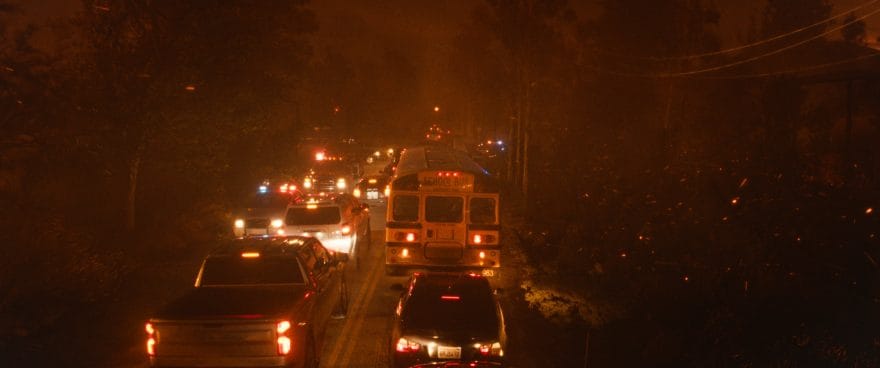
On a normal day with regular traffic, Kevin’s trip from point A to point B would take around ten minutes, but in the midst of a swiftly moving wildfire and the ensuing human chaos, it’s like trying to cross a continent. The Lost Bus is pure, unfiltered terror that feels bigger because it’s based somewhat in reality. Based on excerpts from a book by Lizzie Johnson (Paradise: One Town’s Struggle to Survive an American Wildfire) and adapted for the screen by Brad Ingelsby (Mare of Easttown, Task, The Way Back), the script lends itself well to Greengrass documentary styled approach to devastating spectacle. There are a lot more digital effects here being used to recreate the the fires (many of which make it look and sound convincingly like a looming monster in a horror movie), and Ingelsby imbues this particular material with an unhealthy amount of foreshadowing, but Greengrass’ granular approach to human tragedy remains intact.
And like some of Greengrass’ other works, it might be a bit too much for some to take. A sequence where Kevin hops off the bus to redirect gridlock as flames threaten to encompass an entire intersection is harrowing and topped only by the climactic stretch, which features children having panic attacks, looters, people walking head on into their own certain deaths, and a vehicular journey rivalled only by the likes of Sorcerer and The Wages of Fear. Even away from the heart of the inferno, scenes where firefighters attempt to contain the blaze have to wrestle with the hard decision of containing the fire or letting it all burn in favour of saving lives instead. The Lost Bus is traumatizing, but again, Greengrass never speaks down to the danger and gravity of the situation at hand. Although it’s clear from the spectacular visuals and bombastic sound design that The Lost Bus is made for the theatrical experience, it might work better for some sensitive viewers to watch it at home where they can take breaks. Parts of The Lost Bus make Greengrass’ Captain Philips look like a pleasure cruise by comparison.
In the latter stages, just as things appear to be at their worst, Greengrass and Ingelsby lay the horrific beats on rather thick, sometimes straining credibility in the process, but effectively leaving the viewer on tenterhooks for the remainder of the blazing finale. McConaughey and Ferrara particularly shine in this section as two people with minimal degrees of authority bonding and bickering over logical next steps and how to keep the children calm amid all the chaos and impending danger. But while they’re great at what they do, it’s always clear that the fire and what it signifies to the community is a much larger character. That’s perfectly in line with the kinds of films Greengrass has made throughout his career, and he doesn’t tinker with that formula with The Lost Bus. It’s meant to be harrowing, inspirational, and cautionary in equal measure, and Greengrass strikes that balance with expectedly good results.
The Lost Bus is now playing in select theatres, and will be available to stream on Apple TV+ starting October 3, 2025. It was screened as part of the 2025 Toronto International Film Festival.
