

A post-modern take on classical mythology, Charlie Covell’s highly entertaining and wholly unique series Kaos blazes new paths through ancient, familiar territory. Mashing-up and tweaking various threads of Greek mythology into an intoxicating, hilarious, and sometimes heartbreaking and shocking brew, Kaos has a heightened atmosphere of playfulness and low key malevolence throughout. It also has a lot of confidence and swagger to back up its huge swings. Covell (The End of the F***ing World) seems to subscribe to that old adage that all the best stories have been told already, with the series creator gleefully doing everything in their power to subvert expectations in service of the most bonkers retellings ever mounted. It’s as if a really smart, hyperactive, pop culture savvy nerd adapted random chapters of Edith Hamilton’s Mythology with the style, pacing, and soundtrack stacking chops of Baz Luhrmann’s Romeo + Juliet. It’s a heck of a ride for both the well versed and unfamiliar alike.
Zeus (Jeff Goldblum), King of the Gods, has a lot of worries. Only one of his many immortal or half-breed kids ever comes to visit, and it’s the one who happens to be the biggest disappointment. People on Earth are no longer fearful or reverential towards Zeus. His wife (and sister), Hera (Janet McTeer), is keeping secrets from him. And to top it all off, he has a wrinkle appearing on his forehead, something he takes as a sign of his impending mortality and demise. Zeus believes this is all part of an ancient prophecy coming true, and he’s willing to do whatever it takes to make humans fearful of the gods once again, all while barely ever leaving his palatial estate high atop Mount Olympus.
But Zeus’ former best friends and current prisoner, Prometheus (Stephen Dillane), explains that Zeus’ paranoia isn’t misplaced, and that the old gods are heading for a downfall. The decline of the gods is to be set in motion by three humans who have no relation to each other. Riddy (Aurora Perrineau) is slowly falling out of her love with her superstar singer boyfriend, Orpheus (Killian Scott). Caeneus (Misia Butler) has been trapped in the Underworld for the past decade since his death, toiling away at helping other dead souls move on to new lives while he’s stuck in limbo. And Ari (Leila Farzad) is the daughter of the president of Krete (Stanley Townsend), a woman plagued by grief her entire life who’s growing increasingly disillusioned by her father’s adherence to the will of the gods. All three will play a role in Prometheus’ vision, helped and hindered along the way by a variety of gods, demigods, mortals, creatures, fates, and furies.
Covell’s intense love and respect for mythology will be apparent from the opening frames of Kaos. In addition to crafting opulent settings for both Gods and humans to play in alike (most of them in gorgeous Spanish locations that sub in nicely for Greece), Covell packs the series to bursting with clever visual nods and sight gags that add an extra layer of detail. This world where ancient deities still rule with a rusty iron fist looks authentic and cartoonish at the same time, making it a perfect playground for Covell’s cheeky telling of stories revolving around sacrifice, love, jealousy, death, and familial squabbles. Covell also isn’t afraid of making his stately settings a bit dirty by way of sometimes frighteningly brutal bursts of gory violence that somehow never feel out of step because everything else in this world is so elevated that these moments make sense.
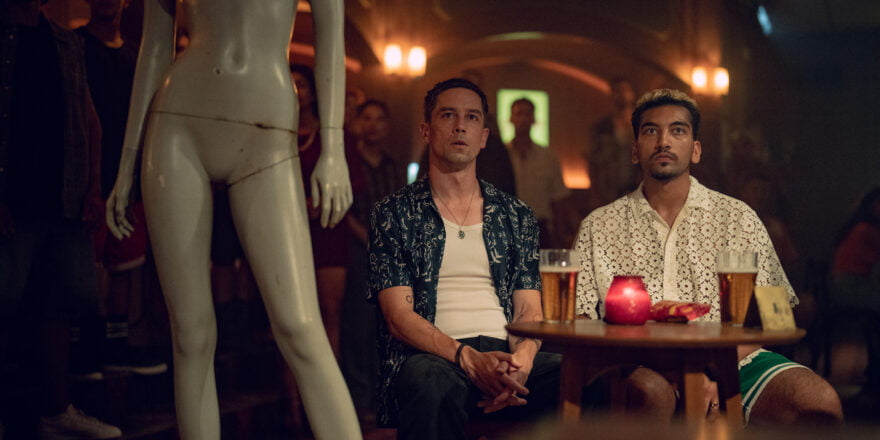
Zeus’ Mount Olympus looks like a Floridian mansion in step with certain other “world leaders” in our era. The streets of Krete are home to the wealthy elites and downtrodden marginalized alike. The colour drained underworld – captured by Covell and company in black and white – is like a dreary factory, led by Hades (David Thewlis), who acts more like a frumpy middle-manager than the God of the Dead. The Furies are a roaming biker gang that exacts justice upon those deserving of it. The Fates – led by a wonderfully campy Suzy Eddie Izzard – run a roadhouse bar in the middle of nowhere. All of the settings in Kaos line up perfectly with Covell’s vision, and all of the tell complete, visual compelling stories the both inform and exist outside the lives of the characters. The visual delights are everywhere.
Kaos doesn’t offer up perfect 1:1 retellings of classic myths, which might irk some purists, but Covell makes up for that by using these familiar stories as jumping off points for a larger narrative with cogent subtextual points about what these tales can tell or warn us about modern society. The worlds of Olympus and Krete are ones where the characters are handed prophecies by fates that are constantly being misinterpreted because they never stop to truly think about what they entail. Love is seen as both a weakness and a strength. People do horrible things in the name of the Gods. Outsiders who have beef with Krete (The Trojans) are marginalized, despite having nothing to begin with. People accept despotic rulers that have been “handpicked” by “God.” People are routinely told they can’t change their station or live their true identity for fear of social and religious punishment. Covell, a non-binary show-runner, mines their source materials to show how little has changed over the centuries, and the ways we find inspiration in characters willing to fight the system, and risible villains in those who seek to oppose the status quo.
To tell such a sprawling story, Kaos has assembled a top notch cast willing to camp it up to appropriate degrees of theatricality, let by a rarely better Goldblum at his absolute Goldblum-iest. His insecurities as a leader are matched in scope only by his ego and unwavering dedication to a tacky, track suit wearing lifestyle of leisure. McTeer, as Zeus’ partner, on the other hand, is open about their ruthless, conniving, and duplicitous nature. Dionysus, the one kid still willing to talk to Zeus and the God of good times, is played memorably by Nabhaan Rizwan, imbuing a character that could’ve been comedic relief with a lot of soul and heart, especially once he starts helping lovelorn and grieving Orpheus on his journey into the underworld. Dillane’s string puller and fourth-wall breaking narrator is able to do more while chained to a cliffside and getting his liver pecked out by birds of prey than most actors can achieve while being active participants in the story. There’s also a great showcase here for the always exceptional and charismatic Cliff Curtis as Poseidon, God of the Seas, who is caught between his loyalty to brother Zeus and his feelings for Hera. Of the humans, Perrinaeu gives a star making performance as the conflicted and confused Riddy, and she has outstanding chemistry with Butler’s kindly, eminently likeable Caeneus; a relationship that gives Kaos a lot of warmth, even though it takes root in a cold, inhospitable place.
In the lead up to its conclusion, there’s a fear that Kaos might’ve bitten off more than it can chew, with some threads requiring further elaboration to be fully satisfying and well integrated. The last few episodes, in particular, appear to be racing through a lot of plot in a bid to tie things up, and some of it is by design and some of it just feels like a result of having to make some cuts along the way to show that must’ve cost a fortune to produce. But those concerns are minimal when one takes into account that there’s literally nothing else out there at the moment remotely like Kaos. It’s a show that reminds people why mythology has created a bedrock for so many epic stores, and it has the power to bring people into the fold that never previously cared about the old tales. Here’s hoping for a lot more to come from this clever, engaging, and smartly conceived series in the future.
Kaos streams on Netflix starting Thursday, August 29, 2024.
