

Series creator and co-star Mae Martin’s unnerving, etherial, and quite often funny thriller Wayward takes a lot of familiar elements and turns them into something refreshing, renewing, and uniquely heartfelt in its moral and ethical complexities. Wayward starts off as a tale about troubled teenagers being forcibly taken from their families and sent to live at a frighteningly strict reeducation facility and the new cop in town who discovers something is amiss. But over time, Wayward becomes something a lot stickier and smarter, tackling not only the ineffectiveness of such institutions, but delving into identity politics, gaslighting, fears of parenthood, and the battle for a town’s soul. It’s a lot for one show to take on, and I hope further editions of this (for now) limited series are on the horizon, but even if it all ends here, Wayward is one of the most fascinating series of the year.
There are two parallel threads to Wayward that overlap: the demoralizing, prison-like life within Tall Pines Academy and the equally surreal and indescribably chipper goings-on in the “progressive, intentional community” that has popped up around it. Abbie (Sydney Topliffe) and Leila (Alyvia Alyn Lind) are two class cutting, inseparable, stoner besties from Toronto who’re always getting into trouble whenever they bother to go to school. Their school principal (Patrick J. Adams) suggests they be shipped away to a place in rural Vermont where self-improvement guru Evelyn Wade (Toni Collette) has set up an academy for wayward youths. When Abbie is forcibly taken from her frustrated family to Tall Pines, Leila makes the unusual and risky decision of breaking INTO the facility to help her friend escape.
The other half of the story revolves around expectant parents Alex Dempsey (Martin) and Laura Redman (Sarah Gadon), who’re moving from Detroit to Tall Pines. Laura is a former ward of the Academy, and clearly has a strange relationship to the town and Evelyn Wade. Alex, a cop, takes a position with the local police station. He’s told that his job will be a relatively easy one, and the community welcomes Alex and Laura with open arms. But it doesn’t take long before Alex has a violent run in with a deeply distressed student trying to escape from Tall Pines, and his suspicions that something is amiss in the town start to take shape. A visit to the centre and the constant intervening of Evelyn in his relationship to Laura only arouse further suspicions. Alex and Leila enter into an agreement where they share information with each other in hopes of exposing what happens in Tall Pines.
Multi-hyphenate talent Martin has previously shown off their talents as a stand-up, musician, visual artists, and performer (most notably with the series Feel Good, which they also co-created), but Wayward is a quantum leap in creativity, difficulty, and homage. Blending elements of folk horror, neo-realism, surreality, and black comedy, Wayward is comprised of touchstones savvy viewers will recognize, but assembled in a way that keeps the viewer guessing. Martin, who has been upfront about drawing on some of their own childhood personal experiences for Wayward, leans into the thin line between new age philosophy based reform schools and modern day cults. Both the school and the town of Tall Pines have been calculatingly constructed to breed individuality out of a person and assert falsely utopian ideals as a means of control and assimilation. The specifics of the town and its insidious uniqueness aren’t fully fleshed out until the final episodes of Wayward, but through a blending of gallows humour, foreboding atmosphere, and realistically depicted characters, Martin and their team make the mystery engaging, even if not all of the threads will come together neatly and there’s still room for interpretation by the end.
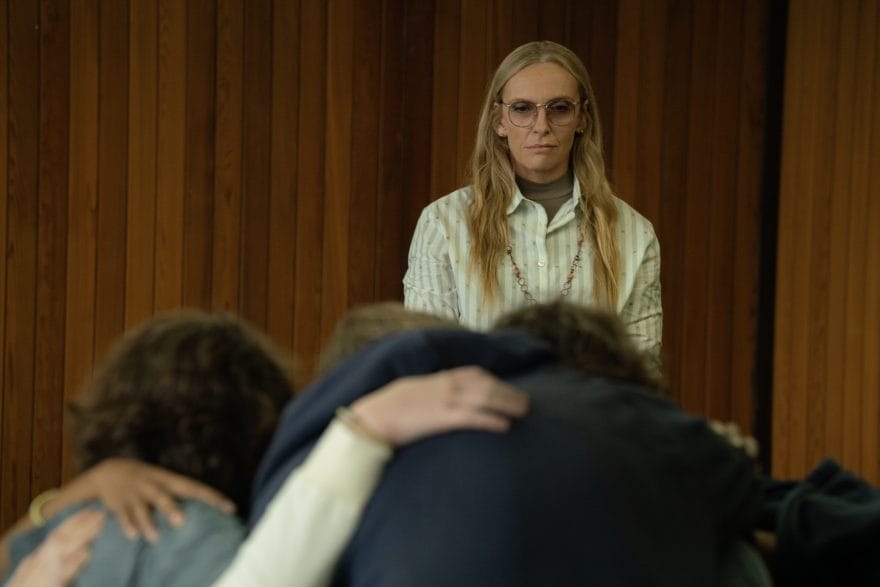
Martin’s approach and dual storylines make Wayward a universally relatable chiller that balances a wide range of perspectives and fears. Whether a young person is merely feeling out of place or they’re facing something a lot more serious like a juvenile detention facility or some form of conversion therapy, they’ll be able to see bits and pieces of themselves in the residents of Tall Pines, most of whom seem like fairly good kids that are being driven further to the brink of self-destruction by Wade’s tactics and methods; which often rewards things like blind obedience, snitching, and Lord of the Flies styled survival tactics. Wade subjects her wards to cruel psychological tortures (a “hot seat” group therapy session that’s more like an AA meeting that’s turned into a brutally unfunny roast) and physical labours (the Sisyphean moving of rocks and boulders) to bring everyone into line, but only the looming threat of physical violence and retribution seems to have the biggest impact on these kids, meaning her approach is essentially worthless, even when things turn towards the metaphysical.
The adult side of the story speaks deeply to loving someone who has clearly been abused returning to the site of their greatest traumas. Martin shines as the concerned partner trying to learn more about their pregnant wife’s past, and also plays a credibly confused cop running into a lot of open corruption. But some of the best scenes in Wayward come whenever Gadon and Collette are paired together, and the former student/teacher dynamic becomes more of a driving force for the narrative. Collette is low key, but gleefully devious as the stern headmistress, but Gadon gives one of her career best performances as a characters whose motivation for returning to Tall Pines becomes increasingly unclear and troublesome.
The trio of adult leads anchor the larger picture of Wayward, but they also never distract from the wealth of young talents that give the series so much heart and perspective. Topliffe and Lind are perfectly paired, both early on when the duo are besties and later when the school’s underhanded tactics and practices have driven a wedge between them. Tattiawana Jones and Tricia Black deliver strong turns as “graduates” of the school who work to enforce Wade’s tough love edicts. John Daniel nicely portrays his sad-sack teenager as someone who lies to be accepted by others. Milton Torres Lara brings depth and empathy to his portrayal as the school’s resident hothead. Isolde Arides is chilling as the closest thing the current student population has to a true believer. All of the young performers and their conflicting personalities and allegiances help to remind the viewer that the point of such a deranged institution is to make the residents deny their pasts to spite their futures.
The conclusion of Wayward is designed to make viewers want more and rewatch everything that came before it, which is bound to fluster some while elevating its esteem for others. It unfolds in a world where everyone acts happy and easygoing, but cruelty becomes incentivized as a way to build trust with those in power. Teens are made to feel worthless and abandoned, only to be screwed up further by bad faith treatments, control exercises, and mind games. The hopes of the school is that these kids (and the adults in their orbit) will simply “play the game” in a bid to get by, making them accomplices in the very system they so desperately want to escape from. There are no easy answers to the depressing situation at hand in Wayward, but the show also never feels so oppressive that it makes viewers want to turn away. Martin wants people to think about what they’re witnessing and asking them to question things in their own lives that they might find off-putting, controlling, or potentially abusive. Wayward turns increasingly bleak in its latter stages, but it’s also uniquely empowering in its cautionary look at alternative living.
Wayward is now available to stream in its entirety on Netflix. It screened as part of the 2025 Toronto International Film Festival.
