
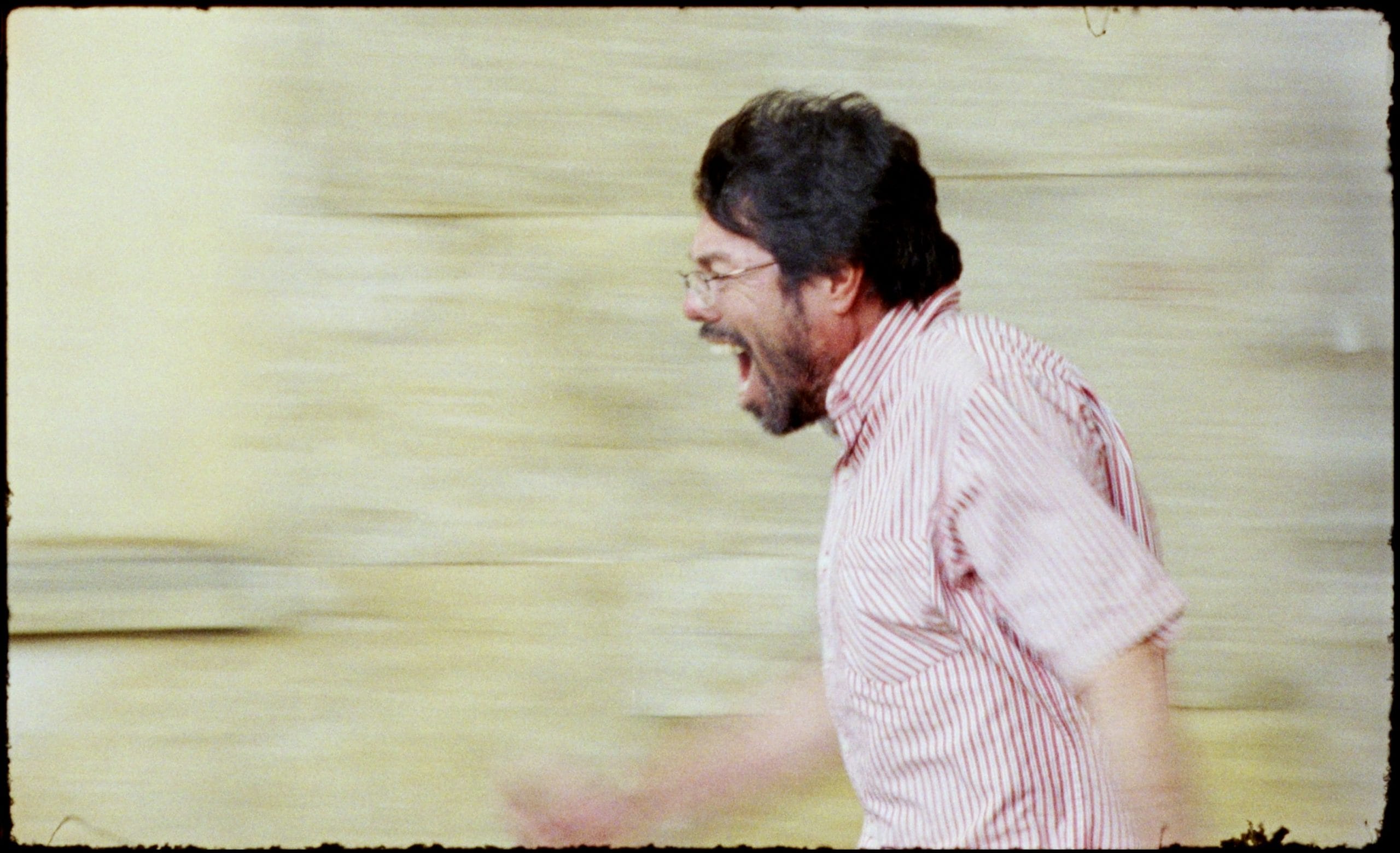
For his wryly humorous and pleasantly ironic dramedy A Poet, Colombian writer/director Simón Mesa Soto follows a conventional formula to tell the story of an obstinate artist who rebuffs his own life as a cliche. It’s a clever, audience inviting gambit that gives some edge to material that could’ve been nothing more than another tale of an inspirational, but flawed teacher mentoring a talented, down on their luck youngster to greatness. And for the most part, Soto’s successful at balancing time honoured story tropes with a story that calls into question the very nature of artistic integrity. Even when it doesn’t work, and Soto heads down a more contemporary, conversation baiting path, A Poet remains an amusing character study about people who seemingly want to deny their own personalities.
Oscar Restrepo (Ubeimar Rios) won an award for a volume of poetry he penned back in 1992 and has been backpacking off that moderate level of professional success ever since. He insists that no one truly understands his genius, and that hardship and poverty are key to helping him create his art. (Which isn’t true, considering that he hasn’t published or even written very much since.) His heroes died in obscurity and poverty, and Oscar seems all too happy to join them. He’s on the verge of getting kicked out of the home he shares with his aging hypochondriac mother, exhausted sister, and fed up brother-in-law. His college bound daughter (Allison Correa) rightfully finds Oscar’s constant begging her for money outside of school embarrassing. He makes terrible financial decisions and has a drinking problem that’s more prolific than his poetry. His only tangible source of employment could come from taking a teaching job, which he refuses until being forced into it, seeing the whole thing as the ultimate sell out move. But upon accepting his new post as a high school teacher, he meets Yurlady (Rebeca Andrade), a fifteen year old from a large, financially struggling family with a noticeable talent for writing and drawing. In Yurlady, Oscar sees someone he can mould into a powerful new voice in poetry, but she isn’t so sure that’s what she wants to pursue in life.
With a colourful, faded aesthetic and the shaggy edges of the film stock aperture visible around the frame, it’s clear that Soto wants A Poet to appear both timeless and of the moment. It’s a clever nod to the kind of archaic aesthetics Oscar would find appealing; raw and uncompromising, but still very much an intentional and calculated choice. Cutting a frumpy, dumpy, nerdy, hunching frame, a perfectly cast Rios is the vision of a modern day loser with few redeemable qualities. He craves recognition and suffering in equal measure. He wants to be adored, but never does anything to manifest such feelings. He wants to kill himself (such a poet thing to do), but he’s a coward that deems himself “a perpetual everlasting dreamer.” He also has a very high level of confidence to go along with his self-loathing; the picture of a person ever determined to always play the victim whenever confronted or called out.
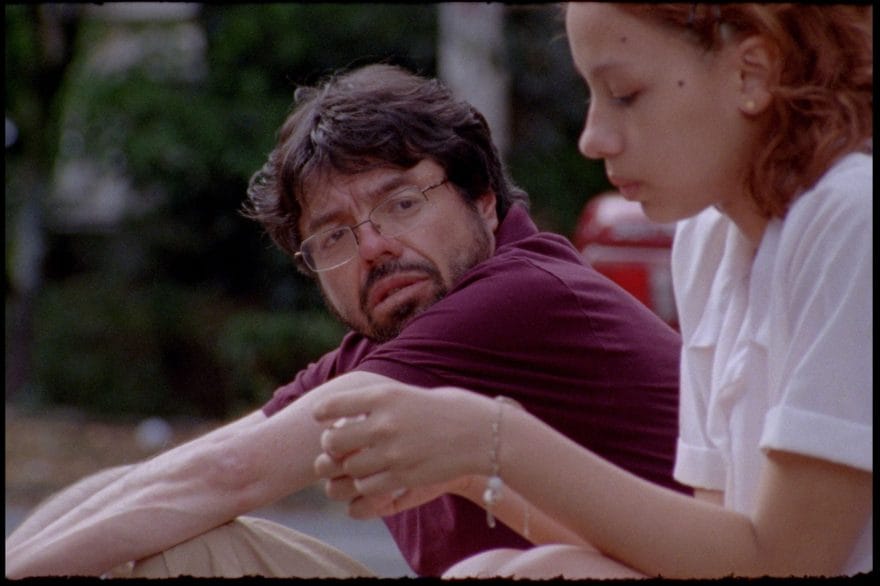
It’s exactly the type of person most filmmakers build redemptive arcs around, especially when those archetypes are put into contrast with the kind of youngster that can achieve all the things they never got to accomplish. And that’s precisely is what A Poet does for about two thirds of its running time. Oscar sees Yurlady’s talent, opens some doors for her, and suddenly realizes that everything he assumed about being a successful poet was either wrong, misguided, or most depressingly of all, correct. Watching Oscar squirm as the excited head of his poetry circle (Guillermo Cardona) tells Yurlady to write a sell out poem about poverty, violence, and fear for her future to curry favour with judges at a major event holds a lot of emotional and artistic truth all around. Oscar might have his approach all wrong and a persecution complex that can be seen from orbit, but his belief that those holding all the power in his artistic community are phonies is spot on.
Whenever Soto sets his sights on the right targets, A Poet rightfully relishes in well placed irony. But at a certain point, Soto goes off on a tangent to talk about cancel culture and things threaten to sour as a result of the added baggage. Yes, it’s another one of those movies that could wrap up a lot earlier and be much more effective on the whole. It’s not that the performances and the world of these characters start to feel false, but that everything that was so well established stops dead to discuss a topic that’s shoehorned into the fabric of a tighter film without a lot of tact or grace. Rios and Andrade elevate the material throughout this stretch, but the points being made about problematic mentorship, buck passing, and ass covering aren’t given the space needed to be talked about in anything more than a tossed off manner.
A Poet rights things again at the very end, sending things out on a touching note, but it’s a coda that could’ve easily existed without the twenty minutes that preceded it. If A Poet, like its protagonist, had a better idea of self editing, this would be a much stronger whole. But even as it stands in its shaggy form, A Poet is the kind of crowd pleaser that’s made for audiences that can’t stand crowd pleasers. Just like Oscar would want it.
A Poet opens at TIFF Lightbox in Toronto, VIFF Centre in Vancouver, and Cinéma du Parc in Montreal on Friday, February 6, 2026. It expands to Winnipeg and Edmonton on February 13, and Ottawa on February 27.
