

Here’s a fun trivia question the next time you want to wow someone with semi-useless movie facts that will only impress nerds: What slapstick family comedy helped to inspire the bleak, relentless 2025 horror thriller Bring Her Back? The answer, of all things, is 1997’s Mouse Hunt (now available on remastered 4K UltraHD and Blu-Ray from Kino Lorber Studio Classics). In addition to citing more obvious influences on their film like the eerie melodrama What Ever Happened to Baby Jane? and Bong Joon-Ho’s true crime inspired Memories of Murder, Bring Her Back co-director Danny Philippou mentioned a particular love for Mouse Hunt, citing the elaborate practical effects being employed and the supposedly innocuous film’s undercurrent of manipulation.
It sounds like a strange point of comparison, but there’s a lot more darkness to Mouse Hunt than those who haven’t seen it or those who might’ve forgotten it realize. Director Gore Verbinski would go on from here to shepherd the first trilogy of Pirates of the Caribbean films, in addition to the nightmarish genre pieces A Cure for Wellness and the well received English language remake of The Ring. That Mouse Hunt has a decidedly gothic look, appearance, and tone certainly isn’t a mistake. It’s a keen aesthetic choice by writer Adam Rifkin (Small Soldiers, The Dark Backward – two films also marked by a balance between whimsy and darkness) and Verbinski. After all, Mouse Hunt is the tale of two brothers trying to navigate a nightmarish scenario from which there’s no escape.
Those hapless brothers are Lars and Ernie Smuntz, played with comedic gusto and tremendous physicality by Lee Evans and Nathan Lane, respectively. Their father (the late William Hickey, to whom the film is dedicated) has just passed away, leaving them only the family’s fledgling string manufacturing business and a crumbling old mansion as their only inheritance of any value. Lars, the idealist of the two, can’t bear to see the string factory sold, but Ernie, a cynical, irritable restauranteur who suffers the worst PR crisis imaginable, needs money in a hurry. It turns out that their mansion is a lost work from a famous architect, one that could catch a pretty penny at auction if they put some sweat equity into fixing the place up. The only problem the brothers can see is the presence of a single mouse. But getting rid of the rodent is easier said than done, and the Smuntz’s nemesis refuses to go quietly.
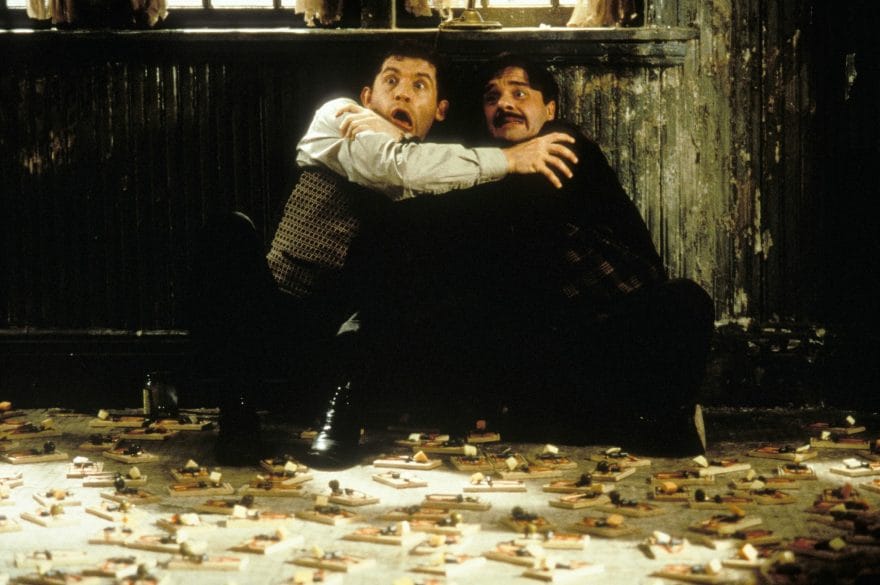
One of the first major theatrical releases from DreamWorks, and a project that was perhaps a hair too late to capitalize on the slapstick craze that was briefly reignited by the release of the Home Alone films around the start of the decade, Mouse Hunt did okay at the box office (releasing amid a positively stacked holiday season slate of releases that included the likes of Titanic, Good Will Hunting, As Good as It Gets, Scream 2, Tomorrow Never Dies, and Jackie Brown), but like many family aimed films, it picked up a lot more admirers on home video. Part of what makes the Kino Lorber upgrade so noteworthy is how it restores the film’s visual splendour to how it once looked on the big screen. Although the film takes place during the chilly holiday season in 1976, Verbinski’s vision for Mouse Hunt is much more in line with Gothic and Elizabethan architecture and design. Even though Lars and Ernie’s mansion is going to get destroyed worse than their dreams by the end of the picture, Verbinski and company spare no expense when it comes to setting a scene.
The mansion is a decaying palace where the mouse’s hiding holes might be homier than the sitting rooms. The Smuntz String Factory is like a Rube Goldberg warehouse, full of outdated machinery that works in the most elaborate, but obviously least cost effective way. When the brothers hit up the local pound to try and procure a killer feline to take care of their vermin problem, the shelter looks like something out of a Terry Giliam movie, not like a mainstream children’s film. Mouse Hunt has a visual sensibility that demands to be enjoyed under optimal conditions.
The same can be said about the praiseworthy blend of visual and practical effects, all of which hold up remarkably well by today’s standards. The camera zips furiously in and out of every nook and cranny behind the walls as the mouse runs to safety. The mouse comes close to meeting its end on the opposite end of a nail gun in a memorably tense scene. The means by which Lars, Ernie, and hopeless exterminator Caesar (Christopher Walken, in a brief, but memorably Walken-y role) are outsmarted, degraded, and punished becomes increasingly unhinged as the film motors towards its grand finale. (Yes, everyone survives things that would kill normal human beings and/or mice, in typical Home Alone aping fashion.) But even when Verbinski tries to pay homage to classic cartoon sight gags – like a single thread pull slowly unravelling an entire sweater – the approach and craft are impeccable.
Mouse Hunt is a stylish crowd pleaser that wears its influences proudly on its sleeve. There’s a bit of Babe, Mr. Blandings Builds His Dream House, Willard, and even a healthy dose of Hammer horror to be found in Mouse Hunt, beyond the obvious Home Alone comparisons. It’s a solid choice for a studio that’s just starting out and trying to be a major player in Hollywood to take on as one of their first projects. The plot is simple, familiar, and easy to understand, but the filmmaker brings a wealth of vision and talent that can turn the whole thing into an eye catching bit of spectacle. It’s the kind of film that can help younger audiences get more invested in the art of moviemaking; a work that one can visually get lost within and still have a silly time.
Mouse Hunt is now available on 4K UltraHD and Blu-Ray from Kino Lorber Studio Classics.
