

Although films already exist about the historical events that transpired in writer-director James Vanderbilt’s Nuremberg, this film examines the trials that forever shaped war crime prosecutions from a different perspective. Based in some parts on Jack El-Hai’s book The Nazi and the Psychiatrist and from various historic accounts for other elements, Nuremberg keeps the spectacle of the courtroom drama at bay as long as it can, with Vanderbilt preferring to focus on a small number of key players and their individual roles in a larger picture. While the film still plays into a number of historical movie cliches (mostly to get across large swaths of exposition), Nuremberg plays more effectively than most of its ilk.
The film opens on V-E Day, with allied forces capturing high ranking Nazi Hermann Göring (Russell Crowe) and his family attempting to flee Austria. Following Hitler’s death by suicide, Göring has become next in line for succession, making him a high value target, alongside other detainees. While many (including the U.S. Congress) seek to hang these men and get things over with, others want to give them all the benefit of a fair trial, which would also serve as a further deterrent and send a wider global message. The prosecution falls mainly on Robert H. Jackson (Michael Shannon), an American lawyer in line for a seat on the Supreme Court. Jackson has to contend with the fact that no one has attempted a war crimes prosecution before, and no legal parameters as yet exist for such a trial.
But before anyone can be put on the witness stand to stand accountable for one of the largest genocides and shows of military aggression in world history, it falls upon military psychiatrist Douglas Kelley (Rami Malek) to determine if those in custody are capable of standing trial. With the help of German translator Sgt. Howie Trent (Leo Woodall) and much to the chagrin of his superior, Col. Burton C. Andrus (John Slattery, who brings some wit to a character who has to provide the most exposition in the film), Kelley attempts to bond with Göring, earning his trust with hopes that if he can get the leader to start talking, the lower ranking men being put on trial will follow suit. With his charm and conversational abilities, Göring endears himself somewhat to Kelley, making the doctor’s decision to break patient-client confidentiality to aide Jackson’s case harder than one might expect.
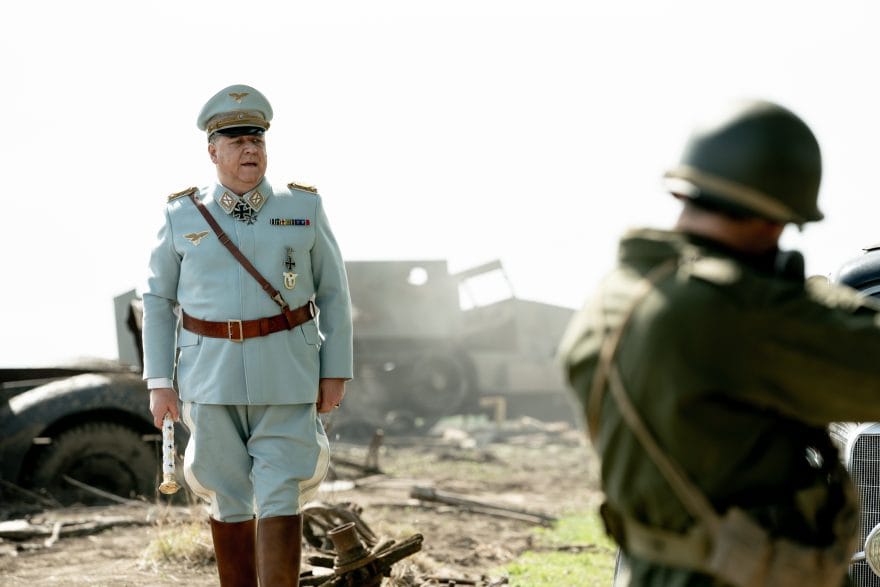
Nuremberg is a condensed look at one of the most public and documented trials in history, and probably the most important when it comes to modern global politics and policy. Vanderbilt (who has worked on everything from Zodiac and Truth to Murder Mystery and recent Scream films) is aiming for a balance between the informative and the entertaining here. Although it clocks in at two and a half hours, Nuremberg is the type of film that knows it can’t encapsulate the entire story of the trials, nor can it give ample time to every person – good or evil – who made them a reality. As such, the global cooperation needed to make the trials happen is mentioned, but never glimpsed outside of the involvement of a single British prosecutor, played by Richard E. Grant. Evil is only seen through the eyes of Göring, and moral ambiguity is only parsed by Kelley. But since the film is centred more on relationships to tell its story, Vanderbilt’s approach works.
The semantic pas de deux between Malek and Crowe gives Nuremberg almost all of its dramatic tension, with the savvy doctor and the practiced narcissist constantly luring each other into a number of emotional and ethical traps. Their scenes together bring out the best in both actors, right down to perpetual eye contact throughout their interactions. Vanderbilt’s peppy and snappy approach to dialogue makes these sequences crackle with tension and without speaking down to the loaded history of what’s being depicted. Better yet, the actors are able to keep the viewer on their toes when it comes to wondering who has the upper hand. Is Göiring preparing to be a leader, a follower, or a coward willing to save himself? Is Kelley getting too close to his subject? Where does their objectivity to their respective causes and professions lie?
Shannon is in top form, but the bulk of his best work comes during the film’s second half, which shifts slightly more into the kind of courtroom drama most might be expecting from Nuremberg. But even the perceived monotony of sitting through another dramatic recreation of the trials is elevated by Vanderbilt’s abilities as a storyteller, always cutting back to other events to provide further emotional and historical context that would be lost by spending all day in a courtroom. Because of the whittled down focus of Vanderbilt’s narrative, the writer-director does have to frame Göring’s eventual testimony in a grand light befitting on the genre, but it’s those beats between that larger, showier moments that give Nuremberg a lot of depth than similarly minded projects tend to overlook in favour of easily digestible tidbits of historical drama.
Nuremberg takes a dark moment in human history and looks at it from personal perspectives. There’s a lot of great character work in Vanderbilt’s film that helps to keep things refreshing and captivating enough for viewers who could feel like they’ve seen this kind of thing before. The outcome is already known, as are many of these players, but it’s remarkable what a few small shifts in perspective can do for a familiar story.
Nuremberg opens in Canadian cinemas on Friday, November 7, 2025. Nuremberg screened as part of the 2025 Toronto International Film Festival.
